Today I am going to share with you the Fall letter I wrote to IMA clients. Due to its length, I’ll break it into three parts. In part one, I’ll discuss the rational irrationality of luxury goods and premium tonics. In part two, I’ll focus on what excellent management looks like at Babcock. And finally, in part three, I’ll conclude by taking you with me to London and Scotland.
Part 1 – The Art of Rational Irrationality
I am in awe of writing—I feel like I’m a guest on this journey. When I sat down to write this letter about my trip to London and Scotland with my son Jonah, I had a plan. I was going to talk about the musicals we saw, compare Scotland to New Zealand – both are green, full of sheep, have rolling hills, people speak with funny accents, drive on the wrong side of the road, and after all of that eventually get around to discussing Babcock’s investor day and how it’s a changed company. But after a few pages I was a bit surprised to discover that this is not where my writing muse took me. We’ll revert to my original plan, but in parts 2 and 3 of this essay.
Babcock – our largest holding and the second largest defense company in the UK – announced that in early September they were going to hold a marine investor day in Rosyth, Scotland (a suburb of Edinburgh). This wasn’t going to be just a presentation in an air-conditioned conference room but a tour of its shipbuilding yards. The moment I heard that, I said “road trip!”
I’m always looking for an excuse to visit Europe, especially when accompanied by my 24-year-old son Jonah. Though he’s well-traveled for his age, he’d never been to London, and I’ve never been to Scotland. IMA also owns two other British companies I wanted to visit – Watches of Switzerland (WOSG) and Fever Tree. Unfortunately, both companies were in their “quiet period” (the time when management is legally not allowed to meet with investors), so instead Jonah and I visited half a dozen WOSG stores in London, including their four-story flagship Rolex store, and did a fair amount of research on mixed drinks in UK restaurants and bars.
But despite not being able to meet with management, this trip turned out to be something even more valuable to me as an investor: a masterclass in businesses that have discovered the art of being rationally irrational.
The World of Luxury
Let’s start with the WOSG – it is the largest “retailer” (more on that later) of Swiss watches in the UK and the US.
When I start doing primary research, I sometimes get a bit too deep, especially if I really like the product. Before we owned WOSG, I was indifferent to mechanical watches, but when I was researching WOSG, I spent considerable time studying the watch industry and began to equally appreciate both the design (the art and craft) of mechanical watches and their marketing. Mechanical watches represent the last frontier of the analog world; everything else has been captured by digital.
There’s something beautiful and weirdly nostalgic about mechanical watches – they are one of the only remaining echoes of the analog past. Spend time with watch aficionados and you begin to appreciate the complexity and nuances of watchmaking – all those exotic functions (mostly unnecessary if we’re being completely honest) that they lovingly call “complications.”
What impresses me most is watchmakers’ attention to detail – their ability to pack so much functionality into a little round case. It’s craftsmanship in its purest form, where precision meets artistry in a space no bigger than a silver dollar.
If you think that the iPhone and Apple Watch have decimated the watch market, you’d be right – but only about the “low-end” of the watch market (those under a few thousand dollars). The high end remains alive and well (though it is coming off a serious pandemic bubble).
That’s because when you buy a Rolex (or any luxury mechanical watch), you’re not buying a device that tells time. You have a smartphone in your pocket, and you can get a quartz or electronic watch on Amazon for $10 (and a beautiful one for $25) that will keep time more accurately than a mechanical watch. What then is its purpose? Put simply, mechanical watches are men’s jewelry.
It turns out that there are several types of buyers of Swiss watches. There are those projecting status. Social scientists call this peacocking, signaling to the world they have extra money for frivolous trinkets (from an evolutionary perspective, they are showing potential mates that they can support them).
Then there are watch enthusiasts who are truly obsessed with them – who know tiny nuances, brand history, how they are made, and which movements they use. If you need a parallel from a familiar universe, think of your favorite American Civil War buff, minus the dressing up and reenactment (my brother Alex and Jonah fit into this category).
And then there are collectors. Some people collect stamps, others cars, and still others watches. (I suppose there is a tiny minority of buyers who actually wear watches to tell time.) I should note that these groups aren’t mutually exclusive and often overlap.
When it comes to marketing, Rolex is the center of my fascination. It is somewhat of a paradox —it is the largest maker of Swiss mechanical watches with about one-third market share, yet you still have to beg your authorized dealer to sell you a watch. It is like a dominatrix for rich people—they have to go through abuse from their Rolex dealers. That’s in part because demand for Rolex watches far outstrips supply (you can see this play out in the secondary market, where prices are often higher than in the store).
It probably costs Rolex less than a thousand dollars to manufacture a watch that sells for fifteen thousand. The gap between those numbers is explained by the story Rolex has so carefully crafted. They’ve mastered not just watchmaking but human psychology, turning a simple transaction into aspiration.
This is where retail comes in. Stores selling Rolex (and most luxury Swiss watches) are not traditional retailers but authorized dealers. Their model resembles auto dealerships: brands give out only a limited number of dealerships and are very selective about who gets them. This changes the business model’s economics and competitive dynamics tremendously, which is why I call WOSG a “retailer” in quotes.
We don’t typically own retail stocks – my EQ is very low when it comes to them, most don’t have moats, and I tend to lose money in them. But I don’t look at WOSG as a retailer; it’s a natural extension of luxury Swiss brands. If Walmart, Macy’s, or Target wanted to get into this business, they wouldn’t be able to. Unlike traditional retailing, where a store chooses which goods to sell from a distributor (and how many), Rolex and other Swiss brands tightly control who sells their watches and how many each dealer receives. Over the past decade, Rolex has been culling the herd—the number of Rolex authorized dealers in the US has declined by about a quarter to about 300, while sales increased.
The beauty of this authorized dealer model is that WOSG doesn’t need to worry about competition from a store opening next door. But they do need to be paranoid about their relationship with Rolex, which wants just one thing from retailers: a perfect customer experience that aligns with its story about its craftsmanship and obsession with quality.
This is why every authorized dealer is micromanaged by Rolex – down to where the Rolex counter sits within the store, how it looks, even what materials are used. If a retailer wants to remodel, blueprints and final design need Rolex approval. I heard a story about a McDonald’s opening on the same street as a Rolex authorized dealer who had operated from that location for decades. Rolex asked the retailer to move. On the surface it sounds absurd, but in my dive into the brand I realized the genius of this approach.
Let me give you a counterexample that illustrates just how crucial this controlled environment is. I was recently walking through a Macy’s store in Denver and saw a counter that sold Gucci watches. It was located right next to the loud, bustling shoe section. The display itself looked slightly scratched up and dusty with dim lighting, as if it had come from a pawn shop selling nose rings. This is precisely why Gucci is not known for its watches.
Our perception of a product is profoundly shaped not just by the product itself but by the environment around it. This insight doesn’t apply only to Rolex and other luxury goods. It’s why Apple is obsessed about the box the iPhone comes in, the look and location of its stores, the customer service experience, etc.
The perception of value imparted by the environment became crystal clear to me when I visited the Rolex store on Bond Street (London’s equivalent to NYC’s 5th Avenue). It was instantly clear that while WOSG may be running this store, it’s a guest at Rolex’s party. Rolex doesn’t want to retail its watches directly but needs partners that will care as much about client experience and storytelling as they do, and in WOSG they found the perfect match. As Jonah put it with a smile, “Watches of Switzerland has soul in the game.”
As long as WOSG continues to tell Rolex’s story to their standards, they’ll maintain that coveted relationship. For us as investors, WOSG is our way to indirectly own part of Rolex, as the brand accounts for a large chunk of WOSG’s revenues and profitability.
There’s another fascinating aspect to Rolex that makes it unique as an investment and explains its willingness to produce fewer watches than the market demands. Its founder had no descendants, so the company was left to a foundation that has an infinite time horizon, not just the next quarter. As a result, the company’s decision-making focuses on maximizing cash flows and preserving its brand; short-term growth is secondary. I wish all my companies could operate with such clarity.
This is harder than it sounds, especially for public companies where management tenure lasts only a few years and shareholders demand quarterly profit growth. Consider what happened to Coach, the maker of luxury handbags. It went on a growth spree and decided to open outlet stores. Its profitability skyrocketed … but then moms discovered their teenage daughters could buy the same Coach bag.
The issue wasn’t just logical (monetary) but also psychological: we hate to admit it, but we constantly compare ourselves to others. When your well-to-do friends carry Coach purses, your purse telegraphs that you share their social status. But when their kids start buying the same purses with their allowance money, the social hierarchy suddenly gets distorted. Demand collapsed, and the brand was nearly destroyed.
Sounds silly? Welcome to human psychology and luxury products, which require an infinite time horizon – a degree of patience that few companies can pull it off.
I am obsessed with quality and even romanticize it. That’s because a focus on quality puts you on the path to constant improvement. I admire companies that put quality front and center. We live in a world that prioritizes efficiency and the never-ending pursuit of lowering costs. That has been the story of industrialization and modern progress. But the artisan pursuit of quality – something you still see in luxury brands like Rolex watches, Louis Vuitton purses, and Ferrari cars – is an attempt to slow down time and elevate craftsmanship over efficiency.
This is why the luxury watch market is rationally irrational. On one hand, it makes sense to strive to do less and get more. Arguably this is why the quality of life has improved so much over the years. Instead of a donkey plowing a field, a mechanized, soon-to-be self-driving combine does the work. But in this pursuit of efficiency, we lose a bit of humanity, and these partially handmade, inefficient products fill that void. When someone buys a Rolex, they’re not just buying a watch – they’re buying into the idea that some things should take time, that mastery matters, and that there’s value in doing something the hard way.
Fever Tree
The same obsession with quality led me to another British company. In 2025 IMA bought a small (“venture”) position in Fever Tree. They make alcohol mixers, and their slogan explains their business model: “If ¾ of your drink is the mixer, mix with the best.”
The more I studied Fever Tree, the more fascinated I became. The company singlehandedly created the premium mixer category. They’ve captured the UK market for premium tonic water – the Brits are fond of their gin and tonic – and are synonymous with high-quality tonic. Just like Rolex, Fever Tree (which is run by a co-founder) is obsessed with quality. Industry interviews are filled with stories of their relentless pursuit of perfection.
And just like Rolex, Fever Tree obsesses over the perception of its product. They cannot control distribution like Rolex does, but they can control the bottle. You won’t find Fever Tree in plastic bottles. Most comes in glass bottles – occasionally cans, but never plastic. It’s priced several times higher than the low-end leader Schweppes, and customers happily pay the premium. After all, they just paid $50 for a bottle of vodka or gin, and want to mix it with another quality product. Charlie Munger could have licensed his saying to Fever Tree: “When you mix a turd with raisins, you get a turd.”
During the pandemic, glass prices have skyrocketed due to supply chain issues. Glass is Fever Tree’s largest cost item, and this has significantly dented the company’s profitability. Management could have relented and switched to plastic bottles, but it decided to endure short-term pain to preserve the brand. I admire that.
Let me make a not-so-obvious confession: I am a disgrace to Mother Russia. I don’t really drink. I haven’t had a straight shot of hard liquor since I was in college, and don’t even like the taste of wine. Part of me wishes I did; wine tasting looks like fun. My wife and I toured Coppola’s winery in Napa a decade ago, and after I sampled half a dozen wines, I politely asked for a beer. I am persona non grata at Coppola’s winery.
But now that I’ve discovered Fever Tree and mixed drinks, my alcohol consumption has gone up from a few drinks a year to a few a month. Since Jonah and I couldn’t visit management during their quiet period, we did field research the traditional way – we ordered gin and tonic everywhere we went (the lengths I go to!). On our trip we tried many competitive products, and though I may be biased, Fever Tree was our favorite by far.
After we returned to Denver, I asked my assistant to buy every Fever Tree product she could find. I wanted to try all the flavors. I posted this picture on x.com (you can follow me on x.com/vitaliyk) with the caption “Another day at the office… We take our research seriously.”

My friend Chris responded, “Now do PM [Philip Morris].” Chris and I are both shareholders of PM, the maker of Zyn, cigarettes, and other nicotine products. But I have to draw the line there: quitting smoking three decades ago was one of the most difficult things I ever did.
Just like Rolex, Fever Tree knows its strengths and weaknesses. They are brilliant at creating outstanding products and brand building, but are not as good at manufacturing and distribution. So they do what smart companies do – they outsource what they’re not good at. Fever Tree just signed a joint venture deal with Molson Coors to manufacture and distribute their products in the US. Get ready to see Fever Tree in more stores and bars over the next few years.
My wife, kids and I rarely drink traditional soda, but after our “research,” we started drinking Fever Tree ginger beer as a treat. It comes in many flavors, has very little sugar, and uses only natural ingredients. This represents a moonshot upside for the Fever Tree investment case – they become “adult soda,” a very nascent category in the UK.
My biggest concern is that management will have to walk a very fine line to stay premium and high-priced. I’m sure if they lowered prices, sales would surge initially, but this would mark the beginning of their demise as a brand. They’d lose their identity, could no longer afford the highest quality ingredients, and most importantly, consumers’ perception that they represent high quality would evaporate.
Part 2 – The Ability to Suffer
Part 1 was hijacked by my writing muse, which took me on quite the detour through luxury watches and premium tonic water. But now that I’ve gotten that obsession out of my system, let me return to what I originally sat down to write about: Babcock, and in Part 3 I’ll discuss London and Scotland.
What brought us to Scotland was Babcock. This is what I wrote to IMA clients in my last letter before the trip:
Babcock keeps reporting great numbers: In 2025, its revenues grew 11% and earnings 17%. The company announced something that (unfortunately) you rarely see with European companies: a £250 million share buyback (about 5% of its shares). It is a much better company today than it was 15 or even 5 years ago. It’s another testament that people make a huge difference. The credit goes to two Davids: David Lockwood and David Mellors.
Babcock was undermanaged by previous management. The Davids simplified the business, flattened the corporate structure (removing layers of managers – a recurring theme in our companies), paid down debt, and improved the company’s performance. Babcock started to deliver products on time and on budget, the relationship with the government (they lovingly call it “the customer”) improved, and now they’re getting more deals awarded. They’re getting these deals not just because UK defense spending is growing but because they’re a better partner for the government.
We’ve been asked by clients about our BAB position size. After I visited the company in January 2023, we increased our position. I have to confess, it’s psychologically difficult to buy stocks that have gone up – at the time, it had already increased by about 50–70%. But at this higher price, the company was actually a better value – the range of possible outcomes was much narrower, its business was improving, and we could see a clear path to success.
Also, there was a significant tailwind behind us. Babcock is the second-largest defense contractor in the UK. The world was getting less safe. At the time, Houthis (Yemeni terrorists) were attacking ships in the Red Sea. The UK is an island nation – its navy is paramount to its security.
The size of the UK navy has decreased by 70% since its peak in the 1990s. Seeing the size of Babcock’s shipyard in Plymouth (the southwest-most point of England) made me realize that this company has an irreplaceable asset that’s not going anywhere. It’s the only shipyard in the UK that can service nuclear submarines.
As we look at Babcock today, the stock is around £10, and our conservative 2029 earnings estimate is about £1 (we are projecting 8% revenue growth) with the stock worth £17-20. BAB, a virtual unknown in the US, was until recently a hated stock in the UK – a so-called “widow maker.” Anyone who bought it over a ten-year period until recently lost money on it. Most institutional and retail investors stayed away from it, and few analyzed it. This is how opportunity was created for us.
However, a rising stock price (in this case driven by much-improved fundamentals) altered the perception of the state of the company and brought investors back into the stock. In addition, now that BAB pays a dividend and has a market capitalization in excess of £5 billion, it has become investable for larger funds that avoided it in the past. In the eyes of investors today, BAB looks like one of the best-in-class defense companies that they can still buy cheap.
We’re going to be very patient with Babcock – it’s like a tanker that has turned and will be difficult to stop. Despite our gains and its size in the portfolio, we think this is an extremely high-quality business with recurring revenues and that there’s a lot more return to come.
When I visited Babcock’s facilities in Davenport (southwest England) in January 2024 during its investor day, it seemed like the company was finally headed in the right direction. Morale was high, the turnaround trajectory was clear, and all that was required was time to execute.
On this visit, the company felt like it was firing on all cylinders. The management team had created a lot of value and future optionality. There was speculation in the FT that one or more Scandinavian countries were considering placing large orders for new frigates, and Babcock had a good chance of being part of the development of new UK nuclear missiles.
At the Davenport event, I sat with Babcock’s chairwoman, Ruth Cairnie. We discussed stock buybacks, and she told me it was too soon – the company had to rebuild its reputation and balance sheet before returning cash to shareholders. When I saw her again, a year and a half later, in Rosyth, I thanked her for eventually authorizing the buyback.
There used to be a saying in the US: “You don’t get fired for buying IBM” – meaning IBM was a safe choice. Under the old management, as the Babcock CFO told me, you could get fired for hiring Babcock – it did not deliver on time, on budget, or on spec. That clearly wasn’t the case anymore. The government was actually seeking Babcock out for contracts.
Babcock’s shipyard in Rosyth was impressive. In addition to building frigates, it makes missile tubes for US and UK submarines, which require incredible craftsmanship and precision – the missile travels hundreds of feet underwater before breaking the surface and eventually heading into space. Even a millimeter of imprecision is magnified a thousandfold.
Babcock’s facility was not quite at Coca-Cola bottling levels of automation, but just a few dozen people operated many robots that semi-autonomously made these monstrous tubes. Sometimes little things (though missile tubes are not so little) tell you a lot about big things. If Babcock can do this well, no project is too complex for them.
A few dozen people attended the event. What I found interesting was that American and UK visitors were allowed to see the missile tube facilities, but for security reasons the French and other EU nationals were not. The UK is the US’s closest ally and their submarine programs are incredibly integrated, which may provide future opportunities for Babcock.
In my previous letter I discussed Huntington Ingalls’ capacity constraints in submarine and shipbuilding. Babcock seems decades ahead of HII’s shipyards (not difficult, as HII’s felt like it was stuck in the disco age – the only thing missing was a disco ball).
Although I suspect Babcock is decades behind Korean or Chinese shipbuilders, I see that as an opportunity. The company’s new management is obsessed with automation, but the transformation is just beginning. They showed us what they lovingly called a “spider monkey” robot that paints ships 10x faster than people.
I keep coming back to the importance of people.
Babcock’s previous management almost ruined the company by overpaying for an acquisition in an adjacent business they knew little about and had no right to succeed in. It became a master of none—the new business was written down to almost zero a few years later, it was a distraction, and mediocrity was allowed to infest its core defense business.
There’s plenty of debate in the US about management compensation. I honestly don’t care how much management makes as long as it’s based on performance. You can overpay a mediocre CEO by $1 million and underpay an excellent one by $10 million.
Compare JP Morgan to Citibank – if Citigroup hired JP Morgan’s CEO, today it wouldn’t be another irrelevant bank. Whether Jamie Dimon makes $10 or $100 million a year shouldn’t matter to JP Morgan shareholders – he created a truly remarkable and resilient company. Did he do it alone? Of course not – good CEOs attract and hire good people.
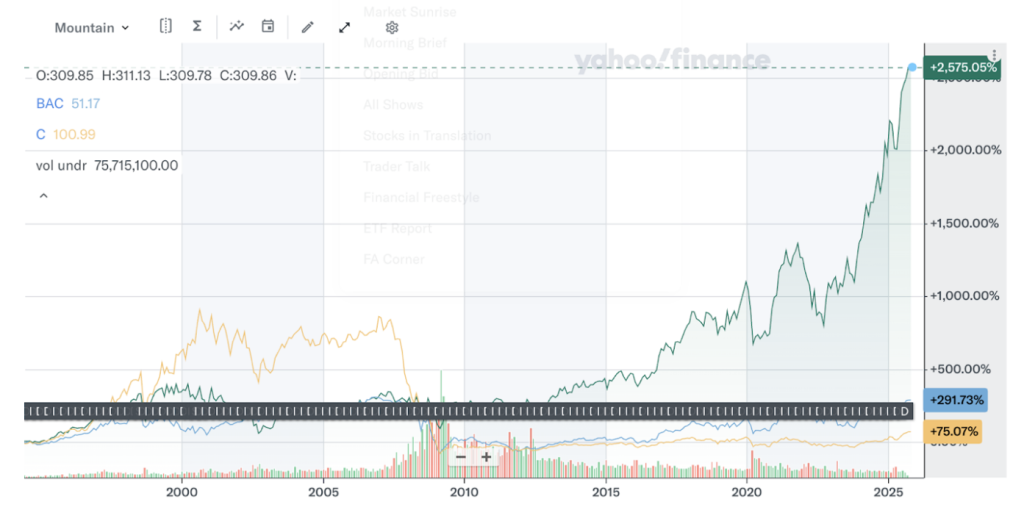
My problem isn’t how much Jamie makes, but how much Charlie Prince (CEO of Citi from 2003 to 2007) made. A few months before the Great Recession nearly took Citi down, Prince famously said (about subprime mortgages), “As long as the music is playing, you’ve got to get up and dance.” He almost danced Citi into the grave. While Prince was dancing, Jamie Dimon was tightening JP Morgan’s lending standards. Citi (yellow line) outperformed JP Morgan (green line) for a while – until it didn’t. The irony is that Jamie was fired from Citi a year before he took over BankOne, which later was acquired by JP Morgan.
The same applies to Babcock management – the two Davids (CEO and CFO) have done an incredible job. Now you don’t get fired for hiring Babcock – you get praised. Think of the jobs they’ve created (and will create), and how much stronger they’re making the UK.
One important quality good management needs to have is the ability to suffer. Yes, suffer! Doing the right thing—not dancing when the world is high on FOMO and engulfed in a giant mindless dancing orgy—is incredibly difficult and painful. It means giving up short-term profits to protect the business from future implosion, whether from bad loans or brand destruction. This requires both high IQ – to see that the party will end in tears, and supersized EQ with giant stamina for the pain of being a lone voice of reason.
I hope you can see why we have an obsession with people who run businesses, not just the businesses themselves.
Management’s ability to suffer is worthless if a company doesn’t have the right board of directors and shareholders, and if an investment firm doesn’t have the right clients. This is why effective and honest communication is essential.
Shareholders and the board trusted Jamie Dimon’s decision not to join Chuck Prince on the dancing floor. This is what gives Rolex an incredible, embedded in its structure, competitive advantage—the foundation has infinite life and is perfectly aligned with building a multigenerational brand.
There are many nuances buried in the above statements, but the message is the same: we want to own companies that are run by management that will not sacrifice tomorrow for today – have the ability to suffer, and where there is alignment between all constituents. Today, Babcock checks all the boxes.
The ability to suffer applies to investing as well—being rational and a lonely voice is incredibly difficult and painful (I can attest to it personally). As one value investor who chose not to “dance” and fill his portfolio with future dot-bombs during the dotcom bubble said, “I’d rather lose half of my clients than half of my clients’ money.”
Amen to that!
I am infatuated with this alignment. This is why I write exhaustingly long client letters – I want you to understand what you own and why, I want my stocks to become your stocks. This is why IMA does not employ a single salesperson—we want clients who choose us with conviction, not ones we’ve convinced to join us.
Most importantly, we want clear alignment between what we do and our clients’ expectations.
Our goal is to get rich slowly. It’s not that we’re opposed to getting rich fast, but that route is loaded with land mines. We are managing clients’ irreplaceable capital—quite frankly, all of my family’s net worth as well as the majority of IMA employees’—and we don’t want to blow up.
This means that at times, when the party is in full swing and everyone is dancing and everyone’s neighbor is minting money, we will be standing on the sidelines until the music stops. In those times, all the ones who are dancing will look brilliant, and we will look less than smart. We are okay with it, and we choose clients who are going to be fine with it, too.
This is where the investor letter ends, and my travel log continues in Part 3.
Part 3 – London and Scotland: Musicals, Markets, and Memories
In this part of the letter I wrote to IMA clients, I’ll take you with me to London and Scotland – the initial reason why I wrote this 14-page essay.
Beyond the business insights, this trip reminded me why I love this work – I get to learn and to see the world.
I adore London and have been there many times, but this time was particularly memorable exploring it with Jonah. In four days we saw three musicals, visited the National Gallery (which is among my top five favorite museums), spent time with friends, had a terrific reader get-together, and walked ten miles a day.
I saw Les Misérables for the first time in London in 1997 when I was 24. Seeing it 28 years later in the same theater with Jonah – who is the same age I was then – was surreal. I’ve written about this musical before as it truly had an incredible impact on me, and I’ve seen it half a dozen times since. It’s my favorite because, unlike most musicals (and quite frankly most operas), it has a powerful, complex, yet aspirational storyline accompanying its incredible music. I had high expectations, but this revival had truly remarkable singers and staging that made you feel like you were in Revolutionary-era Paris.
We also saw The Book of Mormon – we laughed and had a good time, but it’s a “once in a lifetime” experience (i.e., something I’d want to see only once). We also saw MJ – the Michael Jackson show. Though the storyline was hardly groundbreaking, the show was like going to three back-to-back Michael Jackson concerts – one when he was a young boy, another when he was a teen, and the third when he was an adult. Three actors played Michael Jackson, and the singing and dancing were spectacular. I’d see it again in a heartbeat.
To me, London is to NYC what British English is to American English. British English is polished and proper; American English is the wild west. The cities are similar yet different, and I find beauty in both of them. Both have wonderful parks and plenty of cultural opportunities in the form of classical music, museums, and of course musicals. London is older, friendlier for walking, and maybe a touch slower.
From London, we took the Caledonian Sleeper to Edinburgh. We boarded at 10:30 pm and arrived at 6 am (though you did not have to disembark until 8). I really liked it; Jonah (at 6’3”) less so. I’ve taken sleeper trains before in continental Europe, where the sleeping cars were bigger. Though they use the same gauge, the tunnels are smaller in the UK, so the cars are smaller too.
Sleeper trains make a lot of sense – they save you time and money. Today, even a short flight consumes at least half a day. Sleeper trains cost on par with a plane ticket, but you don’t have to pay for the hotel, and you travel while sleeping comfortably (if you are of average height).
Edinburgh is probably the largest medieval city I’ve been to, and one of the most beautiful in Europe. Built from dark brown stone, it feels very Harry Potter-ish at times – in fact the main thoroughfare was JK Rowling’s inspiration for Diagon Alley.
We went on a tour of the Highlands and Loch Ness, which Scotland is trying to turn into a tourist attraction. The loch (lake) is large and quite deep, with murky, cold water. In 1933, there was a supposed monster sighting, and it’s been a draw ever since. England has the royal family; Scotland has Nessie the Monster. It rained half the time we were in Scotland, and I loved it.
Jonah is a good golfer and had dreamed about playing in Scotland, as it’s the birthplace of golf. He played one of the most beautiful golf courses I’ve ever seen – North Berwick, among the oldest in the world. I don’t golf, but was honored to be Jonah’s caddy, pushing his golf bag around the course. It was a very memorable experience and the first time I ever walked 18 holes. I’m never going to take up golf myself – I’d have to give up something else I love, plus I don’t know many happy golfers – but I loved caddying for my son (apparently, it’s customary to tip your caddy, but Jonah must have missed that memo).
We spent a full four days in Scotland, one was taken by Babcock, and we both felt we could have spent another week (at least) to see Edinburgh and the rest of the country.
I love visiting London for another special reason – I have three very good friends who live there – Simon, Ben, and Steve. Simon and Steve I met at an investor conference, Ben at a reader get-together in London a decade ago. Our relationships started out as “investor” friendships and spilled into something more special than that. A lot of my friendships formed like this. Now they are people I talk to a few times a month and see a couple of times a year. I cannot tell you how much I cherish these friendships – they are a big reason why I wanted to go to London.
Jonah has met all of them in the past, and we spent a few hours with each. One of my friends, Steve, and my ancestors came from the same area in Belarus. A few years ago we did a DNA test comparison – we are 8th cousins (0.32% overlap of DNA – our great-great-great-great-great-great-great-grandparents were related). I call him Cousin Steve, and Jonah lovingly calls him Uncle Steve.
But of course, stocks still leaked into our conversations. These fellows are terrific investors, in addition to being awesome human beings. We share a similar approach to investing, and though our portfolios are somewhat different, we occasionally overlap on a few ideas.
Ben was pitching Greggs. For US readers, think of it as Dunkin’ Donuts. Greggs is actually the number one rated domestic UK brand. It specializes in sausage rolls and pastries—very affordable. I was intrigued by the company – it has good unit economics and is trying to break into lunch and dinners, so Jonah and I started visiting it frequently on this trip.
I posted a picture of Jonah and me in Hyde Park. An American investor friend, Drew, texted me that he was in London for a few days. We ended up having a wonderful three-hour lunch.
These trips are multidimensional – they’re not just about sightseeing, learning new cultures, visiting companies, or spending time with your favorite son (my two other kids are daughters). They’re about all of the above, which also includes meeting new and old friends.