
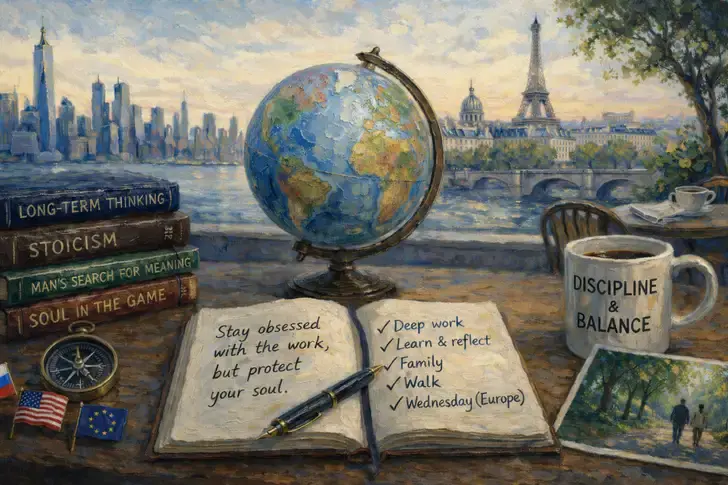
I sat down with my friend Bogumil Baranowski on his podcast Talking Billions. Bogumil asks the kind of questions that make you stop and actually think, which is the best thing a podcast host can do.
We talked about Europe and America, about the pain that comes with investing, about how I hire at IMA, and about why I don’t want to run the biggest firm in the world. I’ve taken some of the questions and answers from our conversation and put them here for those of you who prefer reading to listening.
How has your multicultural background – Russian-born, American-made, aspiring European – shaped your identity?
There is an unspoken conflict between Americans and Europeans. Europeans accuse Americans of being stuck in the rat race. Americans look at Europeans, see them sipping their espressos for two hours a day and reading newspapers, and call them lazy.
Given a choice, I’d choose the American lifestyle. My soul would shrivel if I had to live in a European bureaucracy. While only about 11% of French workers belong to unions, almost all workers are covered by union-negotiated agreements. This creates an incredibly rigid labor market.
Let me give you this example. We own Dassault Aviation, a French company. Most of their revenue comes from making Rafale fighter jets. Today, demand for their jets is insatiable. France has a unique political position.
Let’s say you’re a country like India or Indonesia. You can buy American fighter jets. They may be better than Dassault’s Rafale. But the US at any point can use their jet sales as a foreign policy tool. The US can tell India, if you keep buying Russian oil, we won’t sell you replacement parts for F-15s. France doesn’t do that.
Anyway, demand for Dassault’s jets is off the charts, especially in today’s very unstable political world when Russia is not exporting its MiGs.
Dassault is producing a limited number of jets per year when they could be making many more. But they won’t. Why? We did ask when we talked to Dassault’s management. Their answer was that they are afraid to hire people and not be able to lay them off if demand weakens. The French government wanted to protect workers and created what it thought were worker-protection policies, making it difficult for companies to efficiently manage its labor force.
The issue is that when you try to micromanage the economy, your good intentions – in this case protecting workers from losing jobs – create powerful second-order effects that end up hurting the workers you are trying to help. These policies have caused France’s economic stagnation. This applies to a large degree to the rest of Western Europe as well.
Europeans are also taxed to death. The entrepreneurial spirit, if not dead, is in a deep coma in Europe. They go on sipping their espressos and living a very leisurely lifestyle. I am overdramatizing and caricaturing it a bit. In this cartoon, Americans eat Big Macs at their desks or rush through Starbucks drive-throughs. Americans are obsessed about money, and bigger, better things. Europeans probably would have been doing what Americans are doing if their economies had not been crippled by regulations and bureaucracy.
In all honesty, I don’t like either extreme I painted here. But I am trying to draw an important contrast, and it is easier to do that with extremes.
I love what I do, but I am definitely not motivated by money. I work long hours when I need to. Investing is a weird profession – more hours don’t necessarily lead to better outcomes. But when I get engrossed in analyzing a company, time flows in a different dimension for me. I get obsessed about the work and often ignore other parts of my life. Which can be unhealthy.
This is where I try to inject some Europe into my life, just to protect myself against my American, obsessed self. I drive my daughter Mia Sarah to school. She is in 6th grade. It’s one of my favorite things to do each day. (I have two older kids out of the house, and I cannot tell you how much I miss driving them to school.) I walk in the park daily. We have Friday night dinner with all the kids (this is my wife’s achievement, not mine).
I write every day in the morning.
Wednesday is my European day. I may have a three-hour lunch with a friend, or go see a movie. Neither my family nor my business has a claim on that day. I am dogmatic about keeping these constants in my life – they prevent soul in the game from totally consuming me and my becoming the cartoon version of my American life.
You write about the pain of investing – both emotional and physical. How do you see and experience this?
I wrote a very long and in-depth chapter on this in Soul in the Game, and I won’t retell that story here.
Instead, let me tell you this: Any and every investor will go through periods of underperformance accompanied by pain. At that point, you have three choices: First, you can be fragile – letting the pain cripple you. Second, you can be resilient – going through it unscathed. Finally, you can become antifragile through dealing with the pain.
We need to be careful not to let investing become our only identity. Ideally, it wouldn’t be your identity at all. But I have yet to meet someone who is great at investing and passionate about it without investing becoming part of their identity.
When you go through bouts of underperformance and investor is your main identity, feeling like you’re failing undermines your core concept of who you are. That can cause self-deprecation and mental pain that manifests physically. This is where Stoicism, as I discussed above, becomes very important. Read the “Opera, Pain and Investing” chapter in Soul in the Game for a more detailed prescription of how to deal with pain.
Your last choice is to be even better than resilient, to become antifragile. Pain can forge you (like fire forges steel) into becoming a better investor.
This is what I want to focus on here: Don’t squander this pain. The pain will pass – it always does. In the meantime, you have an incredible (and hopefully rare) opportunity as an investor to improve. This pain exposes every micro flaw in your investment process. Zoom in on these flaws. Study how you can get better. This pain knocks you off autopilot, forcing you to reexamine every part of your process. Viktor Frankl, in Man’s Search for Meaning, teaches that we can find meaning in life in these difficult, painful moments.
I am a much better investor because of my experiences with pain. Thank you, Mr. Market and Ms. Pain. Ben Graham, the father of value investing, was almost wiped out during the Great Depression; this drove him to write The Intelligent Investor.
Tell me about your practice of taking new hires to lunch and observing how they handle a messed-up order. What does this teach you about character?
Work – IMA – is my second home. I spend at least a third of my life here. As CEO, I have a unique opportunity to mold the company into what I want it to be. Of course, I want it to be a place that does great research and takes care of clients, but I also want it to be a place I want to come to. I don’t want us to be another soulless corporation. This is why people matter not just for their competence but for their character.
How someone treats people they consider “below” them socially – a waiter, a rental car clerk – tells me everything I need to know about whether to hire them. Because that’s how they’ll treat colleagues who report to them. They might not treat me that way – I’m the one who signs their paycheck – but people who look down on others will poison the firm’s DNA. I don’t want them here.
Many companies talk about being a team. For most, it’s just a poster on the wall. At IMA, we strive to live it. I’ve found running a firm is like parenting – people watch what you do, not what you say. So I’m the first to be a team player and share knowledge. If anyone needs help, even outside of research, I help them with a positive attitude.
Everyone at IMA has strengths and weaknesses. I see weaknesses as part of someone’s strengths. I’m generalizing here, but usually, creative people are less organized and detail-oriented. It’s up to me to ensure creative people do creative jobs. But creative people may need help with non-creative tasks and vice versa. This is where it becomes a team sport.
I love working with people at IMA, but I have to make sure we get hiring right. Before we send someone an offer, we try to spend time with them in a social setting – going for a walk, taking them out to dinner or lunch. I am absolutely fine that everyone is going to have strengths and weakness (they need to align well with the person’s responsibilities) – we embrace them but are unforgiving with character flaws.
Running IMA made me a better investor because I truly came to understand the importance of people. That changed our research – we now spend as much time analyzing the people who run companies as we do their balance sheets.
“Later in your book, you share that you want your firm to be number one in the world, but not based on assets under management. Tell me more.“
This is almost un-American – not wanting to be the biggest. In America, we have been programmed to always want bigger, which usually implies better things. I don’t see it this way. Bigger doesn’t always mean better, though often it does mean more money for firm owners.
I remember a story by Ray Dalio, founder of Bridgewater. He used to handwrite personal Christmas cards to all his employees. It was easy when Bridgewater was small. He said at the point where the company got to 50 people, he couldn’t do it anymore. At that point, Bridgewater had evolved in his mind into another entity. I honestly don’t know what that “hand-written card” metric is for me. But the personal wealth that managing billions of dollars would bring means little to me. Today my family lives far below our means. IMA employees are well-paid. Growth will be a byproduct of what we do, but not the goal itself.
Any company needs to grow – a statement that sounds like a contradiction of what I said above. Growth is important for employee morale. The beauty of the investment business is that we can grow not by gathering more assets but by doing a great job for our clients – retaining them and then growing with their assets.
It’s easy for me to say this now: We are at scale. If we were subscale, I’d be singing a different song.Kurt Vonnegut once told a story about his friend Joseph Heller. They were at a party thrown by a billionaire. Vonnegut pointed out that their host had made more money in a single day than Heller had earned from his wildly successful novel Catch-22 over its entire history. Heller responded, “Yes, but I have something he will never have: enough.”












comments
0