
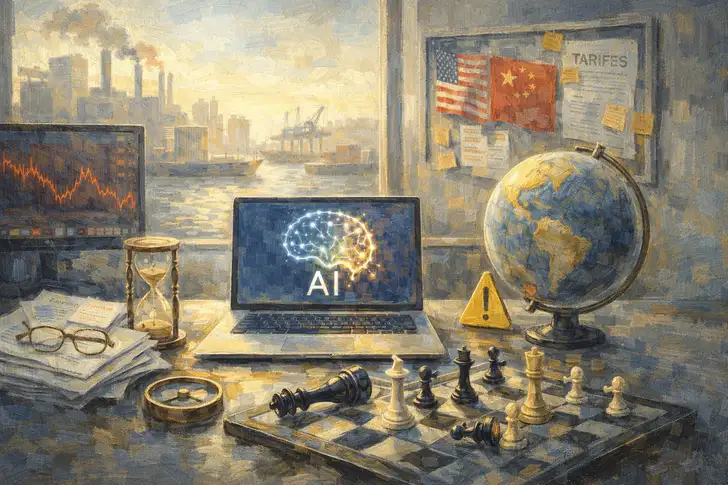
Humility
Clients have been asking about AI, our portfolio, and the world. The honest answer to all three starts in an uncomfortable place.
Not with conviction. With humility.
We are living through a period where change is happening faster than our ability to understand it. The future feels less predictable, not because we know less, but because the range of possible outcomes has expanded.
When that happens, confidence becomes dangerous. Assumptions that once felt stable begin to crack. And the way we think about risk, opportunity, and even our own decision-making has to evolve.
What follows is an excerpt from a recent client letter, and my best attempt to think through that reality.
AI
AI requires an enormous dose of humility. It is changing much faster than our ability to understand the change. AI creating AI makes its growth exponential – something our minds have difficulty processing.
AI is a great benefit, but it is also a threat.
Until recently, the market focused on the benefit part, but there will be losers. Software stocks are a great recent example. Many are down 50–70% from their highs, erasing gains for some of them over the last five years or even a decade.
A lot of them traded at nosebleed valuations, priced for out-of-this-world perfection, and most of these declines are just normalization – bringing some clouds into a multidecade cloudless forecast of uninterrupted growth. But as we spent time researching them, we couldn’t say how this story will play out on an industry-wide basis. What we do know is that the range of outcomes – both positive and negative – has widened substantially.
AI definitely lowers barriers to entry and in some cases switching costs. It reduces boundaries of expansion of existing and new players – you’ll have companies encroaching on each other’s space, benefiting consumers of software but impacting profit margins of the industry. However, the productivity of software engineers will go up a lot. This is a deflationary force – and one that will displace a lot of jobs.
The software industry is the one likely to be impacted first, for several reasons: first, it is the most adept at change; and second, it has been the focus of AI companies, as they are using AI to program AI. Finally, software is at the tip of the spear of AI because it speaks the same language – computer languages. Software engineers get paid a lot of money in part because they have learned to think like a computer. Now they are competing with a brilliant one.
But it is also important to understand that though these companies are in the “software” business, creating software is not everything. They also need to provide support and continuity of updates, have industry knowledge, provide uptime, integrations, security, “throat to choke” – someone reputable to redirect blame to when there are problems – and more. The best products, at least judged on the single dimension of software excellence, don’t always win. Just look at Microsoft. It is a collection of a lot of average products that work well together.
From a broader perspective, a lot will depend not just on individual companies’ competitive positioning, which is paramount, but also on management and culture. Those who embrace change and execute well will create a lot of value. The ones who dismiss it may look fine for a while, until their businesses turn into Kodak camera film. The further we are from tasks that can be put into an algorithm and the closer we are to human connection, the further we are from the spear of AI.
As my friend Saurabh Madan put it, “Knowing what to do and having tools at hand doesn’t mean that companies will do it. It is like everyone knows that we should eat healthy and exercise. Not all of us do it.”
Embracing AI
IMA is embracing AI. It’s easier for us; we are a small company. We can turn on a dime.
We intentionally stayed away from complexity, choosing to do a few things but do them better. We can test and experiment with different models. We can hire consultants to help us adapt.
But at IMA change comes from the top, mainly yours truly. I encourage our folks to embrace it. This is not always easy.
We have great workflows that are running well now. Change requires interrupting those workflows, at first maybe making them worse. Diving into something new and unfamiliar is… there’s no better word for it: scary.
IMA is a small organization that is growing. I don’t want to hire more people. I don’t want an HR department and all the downsides that come with large size. I want us to stay small and agile. Folks at IMA, as long as they have soul in the game and continue to embrace change, have job security here and don’t have to worry about being disrupted by AI; rather, they are encouraged to embrace it.
Large organizations have it harder. They have more bureaucracy, and AI is not perfect; it brings its own risks, just like anything new does. A lot of people are going to fear for their job security.
This is why I think AI’s exponential improvement will at first run into the wall of human biases and insecurities. It will move at the speed of humans.
Eventually AI will overcome them, as more nimble organizations, the ones that embraced AI, will overrun the ones hanging on to the past. It is survival of those who adapt. But it will take time. Though probably less time than past transitions.
We approach AI with a lot of humility and know that if we don’t embrace it, we’ll be run over by those who do.
Diversification
Humility applies to portfolio construction as well. Humility means you don’t have all the answers, you keep an open mind, and you realize that the range of outcomes is wider than in the past. This is why we have been diversifying our portfolio.
I have to pause for a second. I rarely talk about the Bible in these letters, but the story of Noah’s Ark comes to mind: gather two of every kind to survive the flood. This is how Wall Street and academia approach diversification; but as Warren Buffett put it, that’s how you create a zoo.
We are not in the zoo business, just intent on picking the right animals. We look at diversification differently: each independent bet has to have its own risk-reward merit. I am not going to compromise on a company’s quality, management, or valuation just to “diversify.”
We will just have to make slightly more bets.
I hope, as you see from each of our decisions, that we have been uncompromising.
We have more small positions in the portfolio today. Our portfolio will likely grow from 20–25 stocks to 30–35, at least temporarily. I’ll repeat: These incremental positions have to breathe on their own, not at the expense of the rest of the portfolio. The goal is to reduce the idiosyncratic risk that comes from today’s transforming global political environment and fast technological change.
However, an increasing number of stocks brings its own challenges. It can breed indifference to outcomes. When you buy a 2% position, you may care a lot less than about a 5% one. But anything we buy, with very few exceptions, we are ready to increase to a large position as our confidence grows. This decrease in position size is likely transitional, not permanent.
My biggest concern is our ability to maintain high-quality research on a larger number of stocks. This is where AI becomes incredibly helpful. In many cases it has helped us do the same work faster, so the growth in the portfolio has not caused a degradation of research. It is not doing the work for us, but it is helping us go deeper and wider.
Also, an increase in the number of positions doesn’t always mean a linear increase in research. In many cases, 70% of the work is industry research. When we researched tobacco stocks, analyzing Philip Morris helped us understand Altria and British American Tobacco. Instead of buying one company in the space, we bought three, and then reduced to two. The same applies to oil companies, HMOs, and even software.
We are building a diversified portfolio, and thus by construction these companies will be exposed to different risk and reward forces. They will be in different phases of success (or turnaround), different geographies and industries, different corporate sizes.
The end goal of diversification is not really to reduce volatility, though that may be a byproduct, but to avoid permanent loss of capital. I expect that not all our investment decisions will work out. That is almost an axiom of investment math. As much as we work to eliminate this, we will have a few that result in permanent loss of capital. We keep working hard to reduce it.
We have been diversifying away from the US. I am sad about this. I love America; I want it to succeed. But lately we, the US, have been our own worst enemy. Though to a lesser degree than Europe, we get drunk on our past success and start thinking it is a gift from God, not the result of hard work.
We are destroying alliances that made us stronger and that gave us a gift (or curse, depending on how you want to look at it): the global reserve currency.
We are running 6% budget deficits while our debt is at the highest level since World War II – and this is in a benign economy. What is going to happen to budget deficits when we go into a recession? Will they go up to 9% of GDP?
In the past, developed markets traded at a premium to emerging markets; we had a stable political system, a stable and more diverse economy. That premium was earned, not given. And it is quietly eroding. Over the last decade, the delta between the developed and developing world has been narrowing. This is why we have been slowly but surely venturing outside of the US.
Europe offered more attractive valuations, but it has its own set of problems. I have a lot of conflicted feelings about Europe. I really want to be optimistic about its future. I was born in Europe.
I truly hoped that being forced to spend on defense would make Europe more pragmatic and would force it to address the socioeconomic issues of immigration, high energy prices, and insane overregulation. It has not really dealt with any of those problems. I can see it sleepwalking into irrelevancy, one luxury belief, one regulation at a time. It has to have a heart attack – a war on NATO country territory, or economic stress pushing government yields into double digits – for it to change behavior.
So we have been spending more time studying companies in Latin America and Asia.
We are not going to venture into China – I don’t want to wake up one day and find out that a company I thought I owned, I don’t own anymore. Americans cannot invest directly in India, but I don’t think we are missing much; India’s stock market trades at valuations that make the US look cheap. We had a small and successful excursion to Japan.
Our portfolio will look more global in the future than it has in the past. This makes our life more difficult, from research to trading, but I feel it is the right thing to do. This is going to be a slow, deliberate, and again, uncompromising process.
As you know, your portfolio is managed by a paranoid Russian Jew: my ancestors were at the end of the spear of change. I feel like it is in my DNA to worry about risks that may be lurking around the corner.
If you are worried about what is going on in the world today, I am worried even more: I am worried for you and for me, as my family’s net worth is invested in the same stocks as you are. So my advice: since I am going to worry anyway, maybe you need to worry a little bit less. Let me worry for both of us.
Key takeaways
- Leading with Humility: In a world changing faster than we can understand, confidence is dangerous. I’m widening our perspective because the range of potential market outcomes—both good and bad—is larger than ever before.
- The AI Double-Edge: While AI offers incredible productivity, it is a deflationary force that will create significant losers, particularly in the software industry. We are focusing on companies with “soul in the game” that provide more than just code.
- Adaptation is Survival: At IMA, we are actively embracing AI and portfolio management tools to deepen our research; I believe nimble organizations that adapt will eventually overrun those clinging to the past.
- Strategic Diversification: We aren’t building a “zoo” of random stocks. We are carefully increasing our number of positions to 30–35 to mitigate global risks, without compromising on quality or valuation.
- A Global Shift: With U.S. deficits rising and Europe facing “luxury beliefs” and overregulation, I am looking toward Latin America and Asia to find the earned premiums that developed markets are beginning to lose.












0 comments
0