
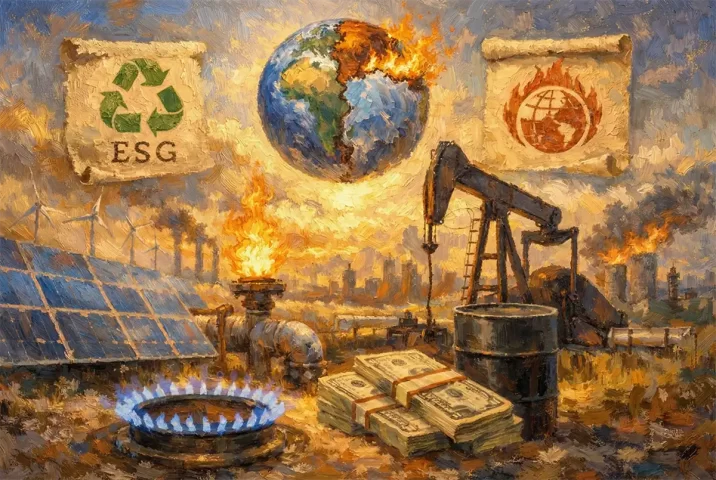
We own several investments in oil and natural gas. I have received inquiries from readers questioning the morality of these investments. In this essay, I address their concerns.
The Church of Climate and the Law of Unintended Consequences
Over the last decade, the global warming discussion has ceased to be a scientific debate and has morphed into something far more rigid: a religion.
You are no longer asked to theorize, debate, and understand; you are asked to believe. This, by definition, is faith, not science. The dogma is strict: you are either a believer or you are a heretic. If you don’t think this has become a religious movement, ask yourself: would people who are utterly convinced that this is a man-made crisis change their minds with the emergence of new, contradictory evidence?
If you are appalled by this phrasing and that I did not immediately signal my virtue in the opening sentence, you are probably already canceling me in your mind.
But please stick with me.
I am an analyst by trade. I look at data for a living. Becoming dogmatic and religious about the non-spiritual world is dangerous in my profession. And when it comes to man-made climate change, I have seen arguments for and against. I question the data quality, the modeling, and most importantly the incentives and groupthink of the people presenting both sides.
My view on this topic is simple and, I hope, intellectually honest: I simply don’t know. Climate is a complex system where the interrelationships among variables are very difficult to assess. Thus, the only rational stance I can take is Socratic ignorance. Even this stance is already getting me canceled by believers and non-believers.
I have a personal rule: I don’t debate religion or politics. I have never seen a person change their mind on these topics during a debate, and life is simply too short for futile arguments. Thus, here I’ll take a more pragmatic approach: It is rational to apply a “margin of safety” and err on the side of assuming global warming is man-caused and real. But, as investors and rational thinkers, we must also weigh the efficacy of our efforts against their costs.
As Milton Friedman famously said, policies should be judged not by their intentions—not by how warm and fuzzy they make you feel during a stump speech—but by their results.
The Road to Hell (Is Paved with Green Intentions)
If we carefully observe how the world has dealt with global warming, we would quickly realize we have failed miserably. The fight against global warming follows a familiar, depressing trajectory (especially when the government gets involved): it started as an idea, mutated into a movement, and ended up as a racket.
We have spent trillions of dollars, and what do we have to show for it?
Take Germany. In one of the most irrational policy moves I have ever witnessed, Germany shut down its nuclear power plants—the only reliable source of carbon-free baseload power.
Instead, this northern country decided to rely on solar and wind. But here is the problem with physics: the sun doesn’t always shine, and the wind doesn’t always blow. To bridge the gap, Germany has to run “peaker” (natural gas-powered) plants that are extremely inefficient and spew CO2.
But it gets worse. To fuel this transition, Germany got hooked on cheap Russian natural gas. In fairness, Germany originally embarked on its “green” journey after the Fukushima disaster, when it vilified nuclear energy. But the height of this insanity occurred in April 2023, when Germany shut down its very last nuclear plants—more than a year after Russia invaded Ukraine—while the country was in the midst of an energy crisis.
Germany used to be a manufacturing powerhouse, famous for chemicals and automobiles. Both industries require cheap, reliable energy. Germany doesn’t have that anymore.
The UK is following a similar script. In its quest to turn green, North Sea gas production has declined roughly two-thirds since its 1999 peak. Windfall taxes have crushed investment. The result? The UK pays roughly four times as much for commercial electricity as the US, and its manufacturing base is shrinking.
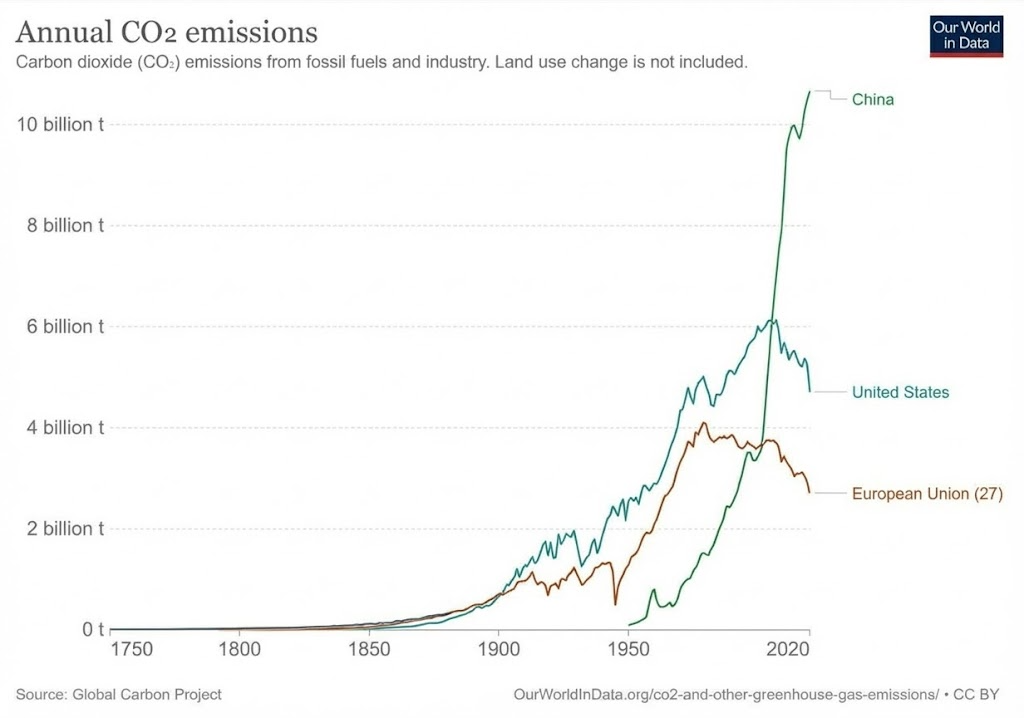
Europe’s CO2 emissions have flatlined, but not because the continent became more efficient. It is primarily because they exported their emissions. They shipped CO2-producing industries (and the jobs that came with them) to China. Consequently, China’s emissions tripled between 2000 and 2023. This is accounting sleight-of-hand, not planetary salvation—we still share the same planet.
The US has spent trillions on green energy: taxpayer-funded companies that went belly up, subsidized EVs, billions on charging infrastructure that still doesn’t exist. Yet much of what we call “green” is just as brown as the petrochemicals it replaces.
There is also the “inconvenient truth” of batteries. While renewables have low marginal costs, we currently lack the minerals to build the batteries required to store that power. And producing those batteries requires an incredible amount of energy—and CO2.
Pause for a second here and think about the real consequences of the policies. We have hollowed out our industrial base because we became uncompetitive; millions of people lost their jobs, and the quality of living, especially in Europe, has stagnated or declined, while China continued to produce what we produced with higher emissions. To China’s credit, it has been very pragmatic and is building hundreds of nuclear power plants.
The Villain Narrative
Every movement needs a nemesis. For the climate movement, it is the oil companies.
The transportation sector accounts for roughly one-third of global emissions. That is significant. Yet, we largely ignore the other two-thirds: heating, agriculture, and construction.
If we truly wanted to solve global warming, we would focus on all industries, not just “Big Evil Oil.” But nuance doesn’t sell. Instead, our policies have been exercises in virtue signaling. They enriched a select few, handed the tax bill to society, and made the West less competitive and less secure.
The Fiduciary Reality
As an investor, my role is simple—my clients hire me to protect and grow their wealth. In other words, they hire me to make them money. The ESG movement, the vilification of oil companies, and the political incorrectness of investing in them have created opportunities; energy stocks were left for dead a few years ago. We took advantage of it.
More importantly for this discussion, I am hired to make economic, not social decisions.
I do not apply my personal social filter when making investment decisions; I let my clients do that. We have a large, diverse client base with varying views on the world. The beauty of managing separate accounts is that we can customize portfolios to fit those views. Some clients tell us not to own tobacco, some have a beef with social media and tell us to never own Facebook (Meta), others have strong views on Elon Musk and ask us not to buy any Musk-related companies. Others ask us not to own oil companies. We even have clients who, due to their faith, don’t want us to own banks and liquor stocks.
We don’t judge; we just don’t buy.
We are not allergic to investing in green energy stocks; they just have to make economic and financial sense—in other words, they have to be good investments (excluding subsidies, which are subject to political football).
In the meantime, I focus on the reality of supply and demand, not the “religion” of the moment. The reality is that the world still runs on energy.
Key takeaways
- Climate debate has become religious dogma, not science – The author maintains Socratic ignorance on man-made climate change because complex systems demand intellectual humility over ideological certainty.
- Green policies have failed spectacularly – Germany shut down nuclear plants for intermittent renewables, becoming dependent on Russian gas. Europe didn’t reduce emissions; it exported them to China along with jobs.
- Oil and gas vilification created investment opportunities – The ESG movement’s demonization of energy companies left these stocks undervalued, which the author’s firm capitalized on while competitors virtue-signaled.
- Fiduciary duty trumps personal politics – As an analyst hired to grow wealth, the author makes economic decisions for investing, not social ones. Clients can exclude whatever they want, but portfolios require pragmatism.
- Reality beats intentions – Judge policies by results, not feelings. Trillions spent on green energy enriched a few, impoverished many, and made the West less competitive while the world still runs on fossil fuels.













We have to separate two things – (a) is man-made climate change due to emission of greenhouse gases the dominant cause of the warming seen over the last hundred years (b) what are the impacts of this warming. The first is not dogma, although it has been made out to be that way due to the fierce opposition to any policy implications. After all, the reason we have a planet with a mean temperature of 15C as opposed to -18C is because of the blanket of CO2 enveloping us in the atmosphere with a corresponding maintenance of water vapor. Famously known as the greenhouse effect. Additionally, we have a measured net energy imbalance at the top of the atmosphere as heat continues to accumulate particularly in the deep oceans which is where 90% of the excess heat resides. The second issue of impacts has more uncertainty, but our knowledge is improving. Having said that, I agree that transportation sector is only part of the emissions. More than 80% of our energy use still comes from fossil fuels including for fertilizers, concrete etc. It is not an easy problem and the most likely path of least resistance is business as usual. But the fierce battle over the last 30+ years that has led to questioning the very real science of greenhouse gases, something that is as real as the cup of coffee you heat in the microwave, is one of politics, not scientific dogma.
This was a timely post given today’s repeal of the EPA endangerment finding. In light of Vitaliy’s comment that he is a data analyst, but questions the data quality and modeling, I would like to add the following data points all from measurements for readers who may be interested:
1. Unadjusted raw data of surface temperatures give pretty much the same temperature graph as those with necessary adjustments.
https://www.theclimatebrink.com/p/the-raw-temperature-deal
2. There is a measured heat imbalance at the top of the atmosphere using satellites where there is more heat entering Earth’s atmosphere than that which is re-radiated back into space and this imbalance is increasing.
https://agupubs.onlinelibrary.wiley.com/doi/10.1029/2024AV001636
3. Most of the complaints about temperature data involve land but 70% of the surface is covered by oceans which do not suffer from things like ‘urban heat influence’. Besides, water has a higher heat capacity and therefore 90% of the excess heat content goes into oceans which show a measured increase.
https://www.climate.gov/news-features/understanding-climate/climate-change-ocean-heat-content
All three of the above relate to measurements, and not modeling. As stated, I agree that there is no easy substitute for fossil fuels for much of industrial needs. Despite my confidence in the underlying science, I too invest in oil companies. I also agree that debate on this is futile. But this appears to be a religion (or ‘scientific’ debate) of the last ten years only for those who started paying attention recently. This has been fought viciously since the 90s. The sheer amount of time spent on arguing issues such as ‘is global warming real’ or ‘did covid spread from a lab’ can be better invested in understanding the science than trying to gauge the vibes from prevailing commentary.