
The following is an excerpt from my latest seasonal letter to clients. Two of the questions I answered were really the same question wearing different clothes: one was about a stock that had dropped 25%, the other about how to tell patience from stubbornness when a position isn’t working.
Both get at something I think about constantly: how to hold a position through doubt without flinching at noise or hardening into ego. Daily liquidity is both a feature and a bug of the stock market, and most of the job of being a long-term investor is learning to take the feature without getting hurt by the bug.
I’m sharing my answers below.
Stock XYZ has declined 25%. What do you think? Is your thesis broken?
I completely understand the concern, and I am empathetic. We are managing your nest egg, and you want to know what is happening to it. This is why I spend months every year writing very detailed seasonal letters.
The response you’ll get from me to this sort of question, though, will be something along the lines of “Thank you for your question. I am going to write about it in the next seasonal letter.” That may not sound like a response from a company obsessed with customer service. But I’d argue it is exactly that — and let me explain why.
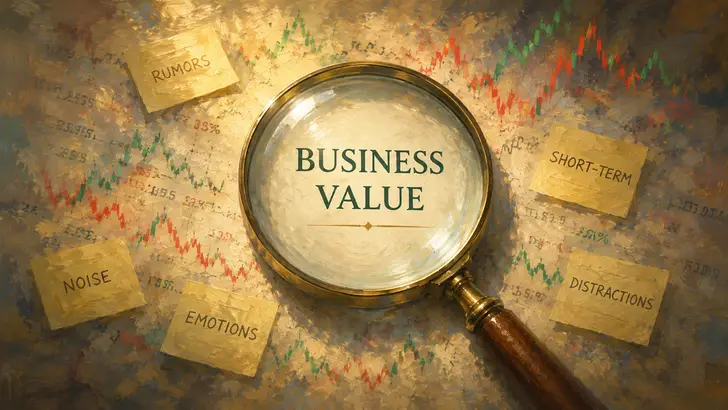
What you observe in stock price volatility is mostly noise. A good chunk of buyers and sellers don’t know much about what they are trading other than the ticker. The “fundamental” investors who actually do research often have the time horizon of a caterpillar, either because of their impatience or because their clients will fire them if they don’t produce short-term results.
When I started investing, I tried to read and understand these stock movements. Then I realized they were mostly nonsense (rationalized and explained by the media daily). Trying to make sense of it is like looking for deep meaning in the poetry of inmates of an insane asylum.
The stock market’s daily liquidity — stocks being priced continuously throughout the day — is both a feature and a bug. If you unintentionally let the market into your life, it will ruin you. The human mind is not built for it; it interprets frequency and loudness as authority. There is a good reason advertisers repeatedly bombard you with the same ads. My job is to not fall victim to the noise and yet take advantage of the short-term insanity — to benefit from the feature, don’t get hurt by the bug. Investing is a mental game. I work extremely hard to resist the allure of daily liquidity and look at companies as businesses, on which the market merely opines.
If you were to pull up your top holdings and look at the charts for 3, 5, or 10 years, you’d see they look like giant rollercoasters, with massive drops and surges. If I were to react to every drop and surge, I’d have even less hair than I have now, and I’d be checking into the asylum myself. Jokes aside, doing so would make me a worse investor and your portfolio would suffer. My time horizon would shrink, I’d be emotional, and I’d be playing a game I cannot win.
When I started investing, I was glued to the computer all day long. Today I look at our portfolio once a day, and some days I forget to look at it. If there is important news, I’ll get an alert, or my analyst Max will text me. Having a long-term time horizon is a valuable asset that has to be guarded like a treasure.
Let me take it further.
Today, I try not to look at the stock price when a company reports its earnings. I read the press release and listen to the earnings call first, then form my own opinion on how the business is doing. I don’t want “the market” to tell me what to think of a company’s performance, because “the market” may be a computer; or a day trader who hasn’t taken a shower in a month and is living in his mom’s basement, trading stocks between Grand Theft Auto sessions; or a fund manager with a mortgage, kids’ braces, and weddings to pay for, just trying to do everything he can to keep his job.
I’ve said this before, but it bears repeating: When we value companies, we are literally looking at cash flows decades out. Daily fluctuations, no matter how dramatic, are noise. And by the time I write the seasonal letter, the noise may have already settled — the stock price movement that triggered your email to me may have already corrected upwards. In fact, this happened with a few stocks in our portfolio this month.
So here is my advice.
Don’t look at your portfolio daily — you are mostly observing noise. Remind yourself that you own a very diversified portfolio. Even if a few holdings go to zero, the losses will not be catastrophic (borrowing here from the Stoic practice of negative visualization). A few stocks will always look like losers — until they don’t. In many cases, they become the next winners. And finally: Your money manager is not indifferent to the outcome. He and his family are in the same boat as you.
Guarding our long-term time horizon against the noise is the job. That is the customer service.
When and how do you decide the difference between patience and stubbornness when a stock does not perform as planned?
I love this question. There is a thin line separating patience from stubbornness, and thus success from failure.
What is the difference between the two?
The difference is subjective and definitional. Let me define them in a way that turns the patient investor into a hero and the stubborn one into an anti-hero (realizing that my definition is highly subjective) — to highlight the nuances of investor behavior.
A patient investor is willing to wait because the data leads him to this conclusion. Patience is a core quality required for long-term investing. In fact, having a longer time horizon than the rest of the market is a significant competitive advantage, as the market is predominantly short-term focused — which creates an opportunity for those who can patiently sit on their hands for longer.
A patient investor is in scientist mode. Just like a scientist, his position is a thesis — a set of assumptions — and thus he is open to confirming and disconfirming data. Actually, open is not the right word — he is actively looking for all data, seeking out the disconfirming kind. (I wrote about scientist mode in Soul in the Game.)
A stubborn investor is engulfed by his ego. He is not willing to change his mind. It is not just that he wants to be right — all of us do — but, more importantly, that he is obsessed with not being wrong. He is sticking to the decision because he has made it, because it is his. He has already made up his mind and is now just cherry-picking data to confirm his unshakable belief.
A patient investor is process-driven, and the process is a living organism — it has plasticity and is in a constant state of betterment. A stubborn investor’s process is rigid, rarely updated, and completely cemented on outcome.
It is hard to distinguish between a stubborn and a patient investor from the outside. Who you are as an investor is only for you (and maybe your psychologist) to know.
Key takeaways
- Stock price volatility is mostly noise. Trying to make sense of daily movements is like looking for deep meaning in the poetry of inmates of an insane asylum.
- Daily liquidity is both a feature and a bug. The human mind isn’t built for it. My job is to take advantage of short-term insanity without becoming its victim.
- A long-term time horizon is a treasure to be guarded. I look at the portfolio once a day, sometimes forget to, and try not to glance at the stock price when a company reports earnings.
- Don’t look at your portfolio daily, and remember it’s diversified. A few stocks will always look like losers — until they don’t, and often become the next winners.
- The line between patience and stubbornness is thin. A patient investor is in scientist mode, seeking disconfirming data. A stubborn investor is engulfed by ego, cherry-picking data to defend a decision because it’s his.













comments
0