
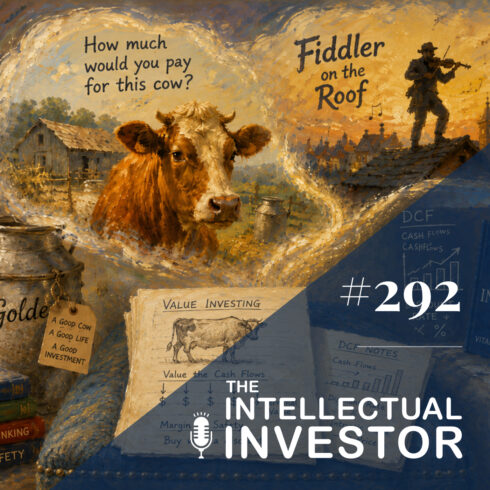
It was 2006, my fifth year teaching a graduate investment class at the University of Colorado at Denver, and I had stopped preparing for lectures. One day I opened the syllabus and found discounted cash flow analysis on the menu. I started with: “Imagine you are a farmer about to buy a cow. How much would you pay for that cow?”
A few days later, on a Saturday morning, I was sitting in my basement working on the valuation chapter of my first book, Active Value Investing. I was stuck. Valuation can be a very dry and boring topic. After staring at a blank screen for hours, I started listening to Barbra Streisand’s “Papa, Can You Hear Me?” from Yentl on YouTube. An hour later I was deep into Fiddler on the Roof, listening to “If I Were a Rich Man.”
And then something happened.
I walk through how my subconscious melded Tevye with that cow lecture, and how I ended up writing a chapter about a Jewish farmer buying a cow named Golde, smack in the middle of a finance book filled with seventy-five charts and tables. It became my favorite chapter by a mile.
From there I get into what almost two decades of writing have taught me: why I show up for an hour or two every morning without word-count goals, why the subconscious is where the magic happens, why storytelling beats sterile facts, and why Steve Jobs was right that you can only connect the dots looking backward. Also, a quiet tribute to my Eastern European ancestors, who were not so different from Tevye.
The full essay is at investor.fm.
_________________________________________________________ 🔗 LINKS MENTIONED: Barbra Streisand’s “Papa, Can You Hear Me?” https://www.youtube.com/watch?v=QwCPAo5e_F8
Tevye was a Rich Man chapter https://investor.fm/tevye-was-a-rich-man/ _________________________________________________________ 📩 Join 100,000+ readers on Vitaliy’s FREE weekly newsletter: https://investor.fm/sign-up/
📚 Vitaliy’s books: Soul in the Game – https://amzn.to/43CF73v The Little Book of Sideways Markets – https://amzn.to/3QWTlqZ Active Value Investing – https://amzn.to/3u8zn3A
🌐 Follow Vitaliy: X/Twitter – https://x.com/vitaliyk LinkedIn – https://www.linkedin.com/in/katsenelson/ Instagram – https://www.instagram.com/vitaliyk/ Website – https://investor.fm/
_________________________________________________________ WHO AM I: Vitaliy Katsenelson is the CEO of Investment Management Associates (IMA) and an award-winning writer. Forbes Magazine called him “The New Benjamin Graham.” His work has appeared in the Financial Times, The Wall Street Journal, Barron’s, Fortune, Institutional Investor, and Foreign Policy. He is the author of three books, including Soul in the Game: The Art of a Meaningful Life. _________________________________________________________ Please read the following important disclosure: https://investor.fm/disclosure/
View IMA’s regulatory filings — including ADV Part 2A & 2B, Form CRS, firm brochure, conflicts of interest disclosures, sample quarterly letters, and privacy policy — at imausa.com.









comments
0