

My dear friend Guy Spier did an almost hour-long interview with CNBC’s Becky Quick. It is an interview I wish had never happened, or, if it did, for a different reason. Guy has been diagnosed with glioblastoma (GBM), one of the most aggressive brain cancers. In January, Guy returned money to his investors, closed his fund, and wrote a must-read letter. Like the CNBC interview, it is full of great insights and life lessons. I am going to link to both at the bottom.
Late last year, Aiden Patterson, a friend of Guy’s, reached out to Guy’s friends and asked them to share their stories about him. He collected them into a book and gave it to Guy. Here is what I wrote.
Guy Spier and I
I first heard of Guy Spier at Charlie Munger’s Daily Journal meeting. I was sitting in the audience when a friend pointed to the silhouette of a man walking away from us and whispered, “That’s Guy Spier.” I had no idea who Guy was, but what struck me was the respect and deference in my friend’s tone when he said Guy’s name. I made a mental note to meet Guy when I got a chance.
Guy and I met briefly at the Value Investing Congress in Pasadena, where we were both speakers. But our friendship did not start until a few years later. Guy and I both attended the Value Investing Seminar in Italy. I was there with my brother Alex, my best friend and dependable traveling companion. Alex has zero interest in value investing or finance, but he’s the one who befriended Guy first. I was diligently listening to presentations at the conference while Alex, who was more interested in local beer at 11 a.m., was roaming the streets of beautiful Trani.
That’s where he met Guy, who, I suspect, did not want to be in the air-conditioned room listening to presentations, either, and was also wandering the streets. Alex and Guy clicked instantly and were soon sharing personal stories and pains as if they had known each other for ages. So, Guy and I became friends through Alex.
One of the first things Guy told me was, “I was observing you and Alex, and I envy the relationship you have. I wish I had the same relationship with my sibling.” Who starts a conversation like this? Guy does. He operates on a different wavelength. He doesn’t do normal.
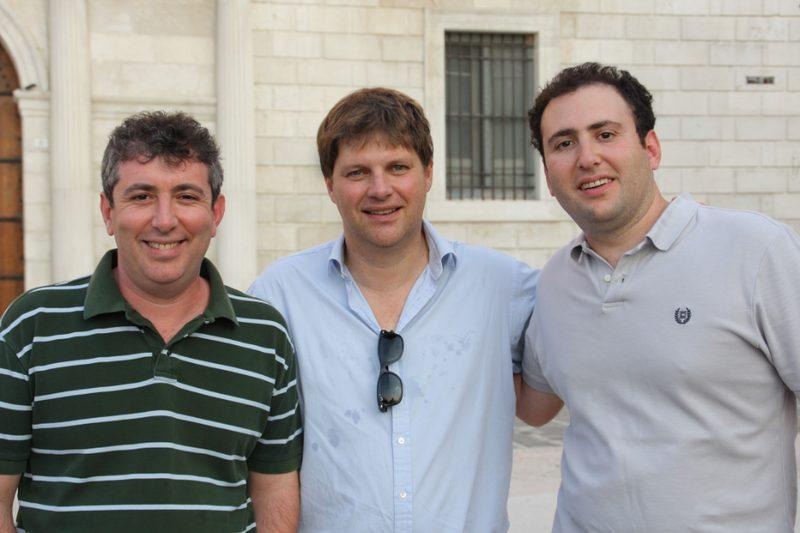
(Alex, Guy, Vitaliy – Trani Italy, 2010)
Guy and I grew closer after I attended his inaugural conference, VALUEx, in Zurich. One evening, the restaurant owner hosting the conference dinner tried to rip him off by charging for a higher guest count. I still cannot fully explain why I butted in to defend Guy. He did not need my defense, but I felt protective of a friend being mistreated.
This small moment meant more to him than I realized. He would often retell the story and add, “Vitaliy would hide me.” He was referring to Buffett’s story about his Jewish friend who survived the Holocaust and divided people into two categories: those who would hide her if the Nazis came, and those who wouldn’t.
Guy is the most charming speaker I’ve encountered. Not to take away from his ideas, which are often brilliant. It’s not just what he says, it’s how he says things. He has the most beautiful, soft South African-Israeli-Oxford-Harvard accent. I remember listening to him at a conference when he was lecturing Swiss financial professionals about being honest and putting their clients’ interests above their own. I looked around and thought, these people are hypnotized by Guy’s voice. It almost doesn’t matter what he says. He could have been sharing a recipe for how to boil an egg, and they’d still be hanging on every word.
Guy went to Oxford and then to Harvard. You’d think that with an Ivy League education you’d only hear proper words coming from Guy’s mouth. You’d be wrong. He drops F-bombs casually. In fact, every time Guy and I finish a conversation, he says to me, “Tell your brother ‘Fuck you,'” and then he laughs. This is classic Guy, and it’s the relationship he has with Alex.
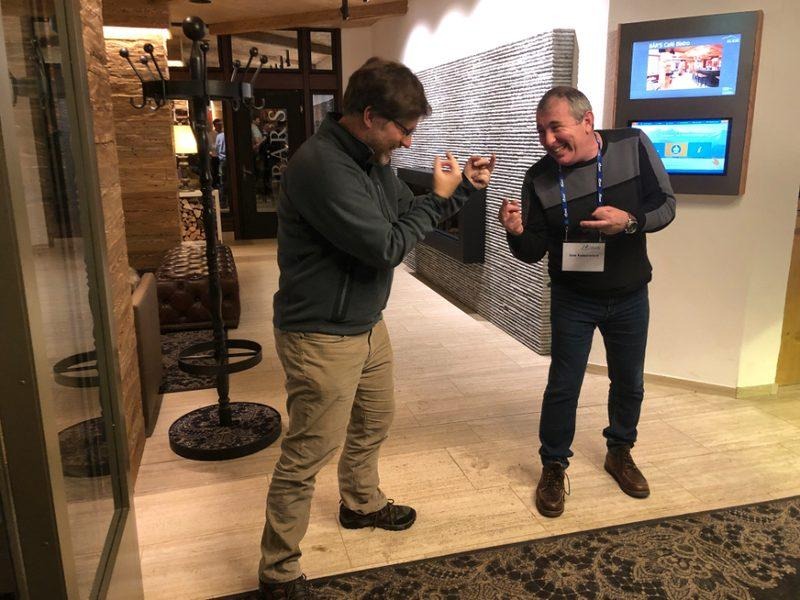
(Guy and my brother Alex, Klosters, Switzerland, 2024)
But beneath the charm and the F-bombs, Guy was an enigma to me. It took me a long time to understand him. He was born in South Africa and raised in Israel, Iran, and Britain. He lived in NYC, and then in 2009, escaping its chaos, he moved his family to quiet Zurich.
Earlier, Guy had been treated as an outsider in Britain, a society that valued pedigree, not merit. This scarred him. Thus, he always overcompensates by trying to bring kindness to others. This shows up in anything and everything he does, including in how much care he puts into introducing speakers at his conference. He is obsessed with making them feel safe and welcome. He wants every new person attending the conference to be introduced to the others. But his generosity goes much deeper than this.
Watching Guy in action showed me what true generosity looks like and made me want to be more like him. I always want to be a net positive to others, but my efforts pale in comparison to Guy’s. He goes out of his way to help others. Sending out books, writing personal thank-you notes, conducting internships at Aquamarine while letting his interns stay at his house, always saying yes to meeting random strangers who are passing through Zurich and happen to write to him—Guy does all that. He is actively trying to inject good into the world.
I saw this firsthand in 2015 when Guy and I went on the CFA European Tour. The CFA Institute of Europe reached out to us and asked if we would speak together in Frankfurt, Zurich, and London. I remember on the first call with the CFA Institute, Guy asked, “How can we help you make it a great event?” That’s Guy. “How can I help you?” is his default attitude.
On the same trip, while in Zurich, Guy, his wife Lori, Alex, and I went to see Bizet’s opera The Pearl Fishers, one of my favorites. What I remember is how thrilled Guy was that I was excited. He saw my face light up, and that was his joy. A giver, not a taker. He recharges his battery of meaning by making others happy.
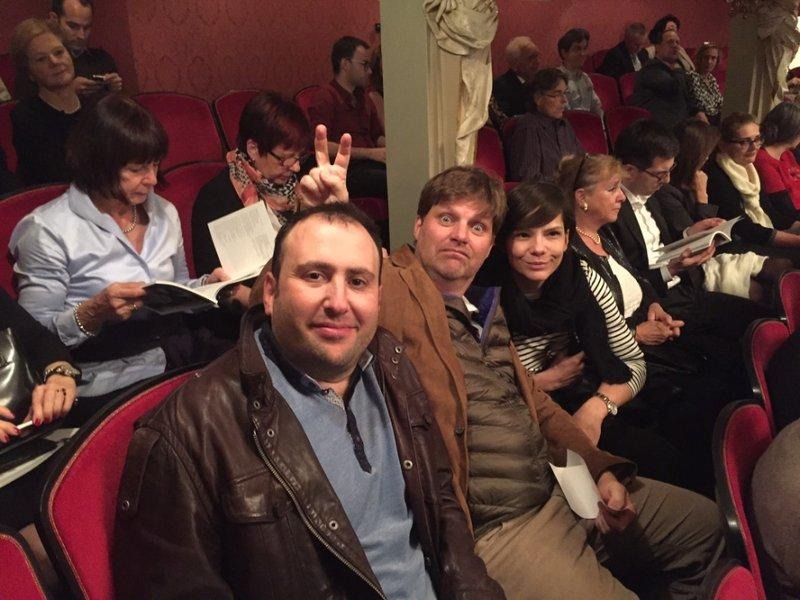
(Vitaliy, Guy, and Lori (Guy’s wife) at the Zurich Opera House, 2015)
This generosity extends to how Guy has always treated me like a younger brother. On our European tour he told me, “Vitaliy, don’t chew gum. You have to wear a nicer suit and better shoes.” If this came from anyone else, I wouldn’t take the criticism well. But it came from Guy, and I knew he had my best interests at heart. (I still don’t do the suit or the dress shoes.)
We were (mentally) invested in each other’s success, and we’d refer clients to each other. It has been a friendship of give and give. Over the years, as he saw my company growing, he’d be celebrating on the sidelines, telling me that once my assets under management got to a billion, he’d send a case of champagne. He’d say, “Your success is my success.” That’s Guy for you.
I love many things about Guy. I love his directness, his honesty (I know exactly where he stands on things), and most importantly that I have a friend on my side of the court always rooting for me. And he would hide me, too.
Postscript
My own mom passed away from brain cancer at the age of 50. It may have been GBM. This was in 1984, in the Soviet Union, and her tumor was not given a name. She went to a hospital a day after her birthday and passed away six months later. Guy has already lived longer since his diagnosis in November 2024 than she did after hers; and with the help of modern medicine, I truly hope he will live much longer than the diagnosis suggests.
I have been thinking about Guy every day. About what he is going through, and about his wife Lori and his kids. I kept thinking that he lives on borrowed time, and then it hit me: we all live on borrowed time. We all secretly deceive ourselves that the nothingness that comes with death is far, far away.
In Guy’s case, GBM may have zoomed in on the goalpost of his journey to that nothingness. But we are all on the same journey. This self-deception we subject ourselves to is both a gift and a curse. It is a gift because if that is all we thought about, we’d be clinically depressed. It is a curse because it robs us of perspective on what is important and what is nonsense. Few things are important, and most things we face in our day-to-day life are nonsensical, unimportant noise.
My twenty-five-year-old son Jonah interned for Guy in Switzerland and stayed in his home before his senior year of college. In January, after reading Guy’s letter, he quit drinking and Zyn (nicotine pouches). He was never much of a drinker, and that is the part that stays with me. He gave up something he barely missed, just so he would not stack the odds against himself. Six months later, he has not gone back. Guy changed how my son lives, and he does not even know he did it. That’s Guy.
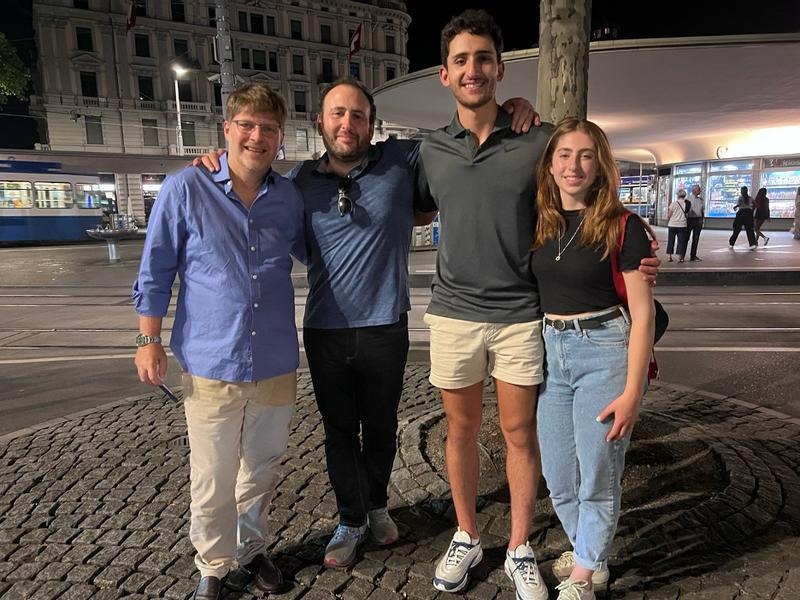
(Guy, Vitaliy, my kids Jonah and Hannah – Zurich, 2023)
In my own case, it magnified what is important and shrank what is not. Let me give you one recent example. We recently bought a house, and per my wife’s wishes we are doing a giant remodel. A lot of decisions—the color of the paint, the hardwood floors, the style of the kitchen cabinets—I now place where they belong on the significance spectrum. Most importantly, I am trying to behave in a way I can be proud of, and the measuring stick for my behavior is kindness, kindness toward the close people in my life and the ones I meet along this journey.
The reason I am sharing this with you is not that life is short, but that we should live it and not squander it on nonsensical noise and petty things. That is important, yet it is still not the core message.
We are all living our eventual obituaries. Guy became famous as a value investor, but this fame is ephemeral. What makes Guy special is his kindness. His ultimate impact is not the compounding of his clients’ assets but the compounding of kindness. He is a true giver. He planted a tree of a wonderful family. He has three kids who are better off for having him as a father, and that matters more than anything he achieved in his career. Guy made the lives of thousands of others better. He always gives more and never asks for anything in return. The person you see in the interview with Becky is the Guy I know. The one who, even in an interview about his own cancer, took the time to show empathy for Becky’s struggle with her daughter’s autoimmune disease—that is the Guy I know, and the person I want to be more like.
I want to invite you to take your time this weekend. First, watch the interview with Becky Quick. That way you’ll get to see and hear Guy. Then read his letter. You’ll be intoxicated by his lovely South African-Israeli-Oxford-Harvard accent as you read it.
I am going to finish this with an excerpt from Guy’s letter:
“Sometimes the music you prepared to play isn’t the music you’re called to play. There is a moment that captures this perfectly: The pianist Maria João Pires is seated at the Royal Concertgebouw in Amsterdam. As Riccardo Chailly leads the orchestra into Mozart’s Piano Concerto No. 20, you see her jolt—she had prepared a different concerto entirely. There is a split second of visible fear, and then she steadies herself, turns to the keyboard, and plays the correct concerto brilliantly.
That is where I am. I was prepared to play the music of compounding capital for decades to come, but that is not the music I have been given. And—unlike Maria Pires at the Concertgebouw—there is no score, so I will have to improvise, to the best of my ability.”
Below I have linked Guy’s letter to his investors, which is a must-read, along with his interview with Becky Quick.
Guy’s letter to his investors












Dear Vitaliy,
Thank you very much for sharing this. I hadn’t heard of Guy until now. I listened to Guy’s interview with Becky and his letter. It was powerful and moving. Inspiring. I will try to pass it on in different ways in my life in future. Thank you.