
This article is best read after “Fiddler on the Roof and Value Investing.”
I was at a conference in Switzerland. A reader came up to me and asked, “Vitaliy, I’ve been reading your articles for years. I’d like to write. How should I start?”
This question spilled into a long conversation over dinner. I told him roughly what I wrote in the previous piece: set a time and a place, and show up for so many hours a day or a week. His face fell a little, and he said, “I knew you’d say that. I tried it. It’s so hard. I’ve spent weeks staring at the computer and wrote complete garbage.”
I could feel and relate to his pain. Welcome to my world, I told him. And then I tried to give him what almost two decades of writing have taught me.
Frustration, garbage, empty pages are par for the course. You have to keep struggling through until you write something you like, something you are proud of. It doesn’t have to be a book. A short story or an article is fine. But once you accomplish it, you’ll feel like a superhuman, even if just for an hour or two. You’ll feel a parental sort of pride and joy over what you’ve written. Bottle this feeling and treasure it. It may be a while before you experience it again. But this feeling is what keeps bringing you back. It is what soldiers you through the weeks filled with garbage on your pages.
In writing, quantity and quality are joined at the hip. This doesn’t mean a longer article is a better article, not at all. But writing is a craft (and an art), and as with any craft, output is directly related to experience. Experience provides muscle memory. It teaches you how to do things better. It gives you the confidence and the courage to keep coming back to the empty, flickering screen. Writing is a journey on which experience helps you find your voice.
The beauty of writing in the digital age is that it is very easy to tinker with what you’ve written. Write five pages, then edit them down to three, then to one. For me, the first draft is just emptying my subconscious.
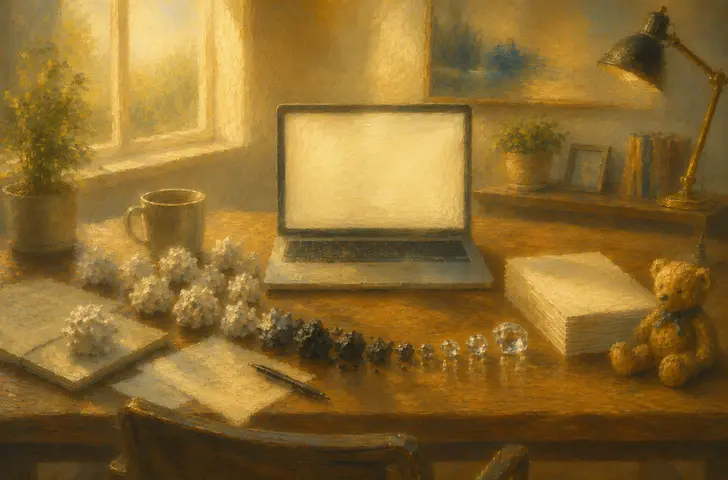
I got tired of my own “garbage” analogy, so here is another one, also flawed. “Writing is rewriting” is not an empty platitude. I live by it. One rewrite at a time, and by the 47th rewrite the pile of coal that was dumped onto the white pages from your subconscious slowly turns into orderly diamonds. It is a long and laborious process.
And then there is voice. Your voice is that internal writing frequency where you have to exert less effort to create. It feels organic, not manufactured. It is you being you. The fastest way to find it is to know who you are writing for. Don’t visualize an empty void; it is very difficult to write for some empty, inanimate purpose. It is easier to write for someone you love or can relate to. When I started writing for TheStreet.com, I could not visualize its readers, so I visualized my friends. They were the first victims of my writing. I unilaterally decided that I shall write, and they shall receive. And receive my emails they did. I kept them in my mind’s eye as I wrote, and that kept my voice conversational.
I said some version of all this to him over dinner. He listened, and somewhere in there his struggle stopped feeling like his alone and started feeling like everyone’s. Then he brightened and said, “Maybe I should hire a ghostwriter.”
“It depends on why you want to write,” I replied. “You told me you’d like to pass your lessons on to your son. If that is all it is, a tome of your thoughts for him and nothing else, then sure. But if your goal is to discover what you think, if writing attracts you as a creative endeavor, then hiring a ghostwriter is like deciding to get healthy and hiring someone to go to the gym for you. To paraphrase Anaïs Nin, ‘I write to taste life twice, in the moment and in retrospect.'”
This conversation made me rethink something important about writing. I used to believe that everyone should write. After all, writing takes you on a date with your subconscious, and few activities do that. But this conversation made me realize that if we are going to commit ourselves to any creative activity for a long time, we need to have a “why.”
“Why” is a deeply personal reason, something that brings meaning to you and only you. What lies on the other side of a completed article, the knowledge I gain, is my “why” for writing. I enjoy the pain that comes with writing about as much as any non-masochistic human enjoys a trip to the dentist. But the “why” is what pushes me through that pain and gets me to the blank screen each morning, knowing another difficult and frustrating few hours may be waiting for me.
Happiness in life comes from having good problems. Writing, just like investing, is a good problem for me. It adds meaning to my life.
If you don’t have a “why,” then, well, let me give you one last example. I’d like to paint. Actually, no. I’d like to have painted beautiful paintings. Just as my reader friend might like to have written. Learning to paint is a lot of hard work. Unlike my father and my brother Alex, who get incredible creative satisfaction from painting, I don’t. I tried. To quote my son’s favorite artist, J. Cole, I don’t find “beauty in the struggle” when it comes to painting. I don’t have the “why.” So I don’t paint.
So if you want to write, figure out whether you have the “why.” If you don’t, find something where you do.












comments
0