
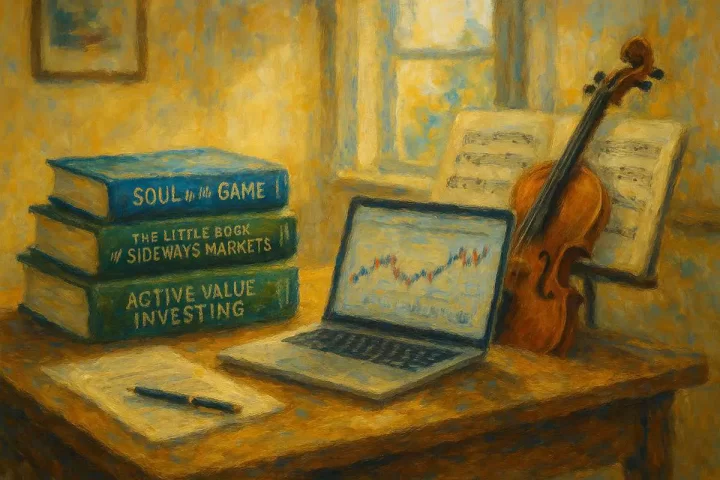
Today, we’re diving into two questions from readers that are close to my heart:
- Which of my books is my personal favorite and why?
- Is there a similarity between classical music and investing for me?
These questions give me a chance to reflect on my journey as a writer and investor, and to explore the unexpected connections between seemingly disparate fields. We’ll touch on the role of confidence, creativity, and continuous learning in both writing and investing. And we’ll see how my passion for classical music has unexpectedly informed my approach to the financial markets.
You’ve written some wonderful books, such as Soul in the Game and The Little Book of Sideways Markets. Which one is your personal favorite and why?
I don’t have a single answer.
My first book was Active Value Investing – I started writing it in 2005 and finished in 2007. This book is special to me because it opened a lot of doors for me. The world started to take me a bit more seriously. Once you publish a book, since you know 80,000 words, you become special. I still don’t get it. But I don’t make the rules.
Be that as it may, this book gave me confidence in myself.
I keep mentioning confidence. I may have entered into this world with less confidence than most people, so I found building confidence was very important to my development both as an investor and a writer.
In my writing, confidence gave me permission to do more. The difference between investing and writing is that the cost of being wrong is higher in investing. I am in charge of someone else’s life savings; and when I say “I don’t know,” I have to move on to something where I have greater expertise or better understanding.
In writing, when I push into new areas, I learn a lot. If I make a mistake, I correct it. Though I impact a greater number of people through my writing, the negative impact is unlikely to be big, even if I embarrass myself when I push into new areas, so be it. Also, I don’t agree with everything I believed five or ten years ago.
Ironically, as an investor, confidence gave me permission to do less, to walk away from difficult investments and companies with complex financials. I came to feel more comfortable saying “I don’t know.”
A great example would be my work on Tesla. I did months of research, learned a lot, and wrote a very long research report (which later turned into a small book). But I could not bring myself to buy Tesla stock, though I bought two of their cars.
From today’s perch, not buying the stock looks like an error. But knowing what I knew then, I’d make the same decision. Today, Tesla should trade at a higher price than it did in 2018. The company’s business has reached escape velocity (scale); it is not at risk of diluting shareholders or going out of business. But the company is likely tremendously overvalued.
Some people asked me if Tesla was a waste of time. Not at all. The beauty of knowledge is that it is cumulative. Studying Tesla and adjacent industries helped me to make other investments.
I have confidence in studying and learning about areas that lie outside of my previous circle of competence, but also confidence in not doing anything immediately with this newly acquired knowledge. I have confidence in not forcing a decision if I don’t come to a clear conclusion.
I had never thought about it this way, but there are nature and nurture confidences. Natural confidence is given – I was shortchanged by Mother Nature. Nurture confidence is earned. Investing experience and writing earned me some nurture confidence.
Back to Active Value Investing. From a reader’s perspective, this book was written as a textbook for value investing. If you’re into the nitty-gritty of value investing, this book is for you.
There was also a great bonus that came with writing this book, when my father, who edited the Russian edition of the book, finally stopped thinking that my day job was legalized gambling.
The Little Book of Sideways Markets is a rewrite and edit of Active Value Investing, brought down to the level of your average neighborhood dentist – a smart, educated person but not a daily stock market warrior. (If you donate money to these charities, we’ll send you signed copies of both books.)
As a writer, I was given an opportunity to improve my writing (authors rarely get this chance) and distill Active Value Investing to its essence. It is a much easier and better read than Active Value Investing. However, I would not have been able to write the Little Book of Sideways Markets if I had not written the big book first.
Soul in the Game – The Art of a Meaningful Life is the book I want to be known for as a human being. Where my first two books may help you to become a better investor, this one has a single focus: to help you become a better human being. I keep saying “you,” but writing changes not just the reader but the author as well. Soul in the Game has changed me; it has made me a better person.
In large part I wrote this book for my kids. In the dedication I wrote, “To Jonah, Hannah and Mia Sarah, because you don’t read my emails.” I meant every word of it – the new generation is not big on emails, and my articles will disappear into the aether – but not this book (I hope).
Then there are also two other books – both are still unfinished. I’ve worked on The Intellectual Investor for a year and a half. I put it away for six months, came back to it, and did not like what I saw. It is on ice for now. However, I am proud of the introductory chapter, called “Six Commandments of Value Investing,” and released it for the world to read – you can get it for free at SixCommandments.com. I am going to come back to this book eventually; I am just not ready yet.
I am also working on volume 2 of Soul in the Game. I have written a dozen chapters. If you would like to read some of them, you can find instructions for doing so on soulinthegame.net.
I cannot tell you how much joy I experience in working on these chapters. I have no deadlines – the publisher doesn’t even know I am working on it. I am focusing on an audience of one – yours truly.
In all honesty, these two books are the ones I am excited about the most. The books I have written are in the past. As Steve Jobs said, you have to live your life forward.
Is there a similarity between classical music and investing for you?
The output of art touches your heart, where the output of investing lands in your wallet.
I did not start listening and writing about classical music because I thought it would make me a better investor. I stumbled into writing about it for no reason other than I love listening to it. I wanted to learn more about it. Some people play instruments; I don’t. Writing was my way of getting closer to this amazing music.
What I found is that creating classical music and the investing process have similarities. The parallel, the connective tissue, between making classical music and investing is creativity.
Most people don’t think of investing as a creative activity. Numbers, financial statements, and spreadsheets are usually not the hallmarks of creativity. In fact, they are usually considered antithetical to creativity. Investing and creativity is the topic of my unfinished book The Intellectual Investor.
Finding new, often different ways to look at what everyone else is looking at is creativity.
Composing music and investing require access to the supercomputer of the subconscious mind. They are nonlinear activities (input and output are not directly, but rather loosely, connected), and they bring a lot of creative joy with them. There is also a lot of creative pain in both, as well as the pain of failure. In Soul in the Game, I wrote about painful periods in my investing career and compared them to what Rachmaninoff struggled with in creating his first symphony.
Key takeaways
- Confidence is earned, not given – Writing my first book, Active Value Investing, gave me the confidence to explore new territories as a writer and, paradoxically, the confidence to say “I don’t know” more often as an investor. Natural confidence may be lacking, but nurture confidence comes through experience and accomplishment.
- The cost of being wrong varies dramatically between fields – In investing, I’m responsible for people’s life savings, so uncertainty demands stepping away. In writing, mistakes are learning opportunities with lower stakes, giving me permission to push into new areas and evolve my thinking over time.
- Knowledge is beautifully cumulative – My months studying Tesla, even without buying the stock, weren’t wasted. That research informed other investments and expanded my circle of competence. Sometimes the greatest value comes from what you choose not to do with newly acquired knowledge.
- Soul in the Game represents my deepest purpose – While my investing books may help you become a better investor, this book focuses on helping people become better human beings. I wrote it primarily for my kids, knowing that emails disappear but books endure, and it has genuinely changed me as a person.
- Creativity connects seemingly disparate worlds – Classical music and investing both require accessing the subconscious mind’s supercomputer, finding new ways to see what everyone else is looking at. Both are nonlinear activities that bring creative joy and creative pain, making the artistic and financial pursuits more similar than most people realize.













building community of Christian