
Today I’m sharing a letter that took me almost a month to write. Once I finished, I realized I was writing it as much for myself and my colleagues as for our IMA clients. This letter helped me examine what’s important—my why. I hope you find it useful.
Dear Client,
As my kids got older, I lost my father, wrote two books on life, and crossed to the other side of life’s dial—something in me changed. My focus shifted from me to you, from taking to giving. I realized that my professional center—IMA—needed to reflect this as well. This was a decade-long journey that I’ve finally put into words.
This is our promise to you.
Our Masterpiece
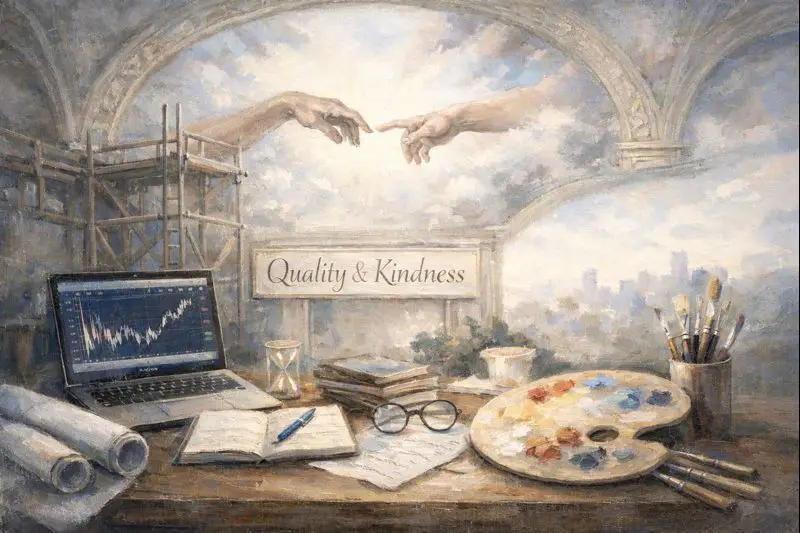
Warren Buffett has talked about how Berkshire Hathaway is his own Sistine Chapel. I love this analogy. I can visualize Michelangelo lying on his back on scaffolding forty feet above the chapel floor, arched backward, paint dripping onto his face, his neck cramped, the frustration of plaster drying and leaving little room for error. The sheer commitment of spending four years obsessing over details that visitors centuries later would need binoculars to fully appreciate. Michelangelo wasn’t just decorating a ceiling—he was creating something transcendent, one brushstroke at a time.
Buffett built Berkshire Hathaway from a much less physically strained position, sitting in an air-conditioned office in a comfortable chair with his feet up. Yet, I can see him “painting” his ceiling one annual letter at a time, one carefully chosen acquisition at a time, one shareholder meeting at a time. Living in Omaha, a thousand miles from Wall Street, he chose the harder path—he ignored the quarterly earnings dance it demands, focusing instead on the patient accumulation of great businesses, the careful cultivation of culture and managers who think like owners, and the decades-long compounding of capital.
Buffett’s Sistine Chapel analogy touched me because it showed that a business could be more than a soulless profit machine—it could be art, something permanent, deeply personal, an expression of one’s values, and a force for good in the lives of others. It also showed that the framing of what we create matters—it can elevate us and give us meaning, or, if posed poorly, shackle us. When Buffett reframed business-building as creating his Sistine Chapel, he didn’t just change how he thought about Berkshire, he changed what Berkshire became.
A Life Decision
This is how I look at IMA. It is not just a profit machine—this is my passion, obsession, and professional creation. I draw inspiration from Max Büsser, the founder of Swiss watch company MB&F. Max left a successful career running an old Swiss watchmaker to start his own company, where he broke two-hundred-year-old watchmaking traditions and turned watches into a true art form. When he made this incredible leap, he said, “It is a life decision, not a business decision.”
IMA is a life decision for me as well. It’s the ultimate singularity of purpose—the alignment between my passion (more like obsession) and what I get the privilege to do every day—something I hope to continue until my last breath. I get to do what I absolutely love—invest and write—and in doing that I’m building an institution that enriches the lives of those it serves. Not just for this quarter or this year, but for decades.
I’m not getting up in the morning energized by the growth of my bank account. Money is a byproduct, a natural result of value created, but not a purpose. A question I’ve puzzled over: If this is the case, why charge for something I’m willing to do for free? Why do I even charge for my books, given that writing them makes McDonald’s wages enviable? When people pay for my creation, there is meaning in that exchange. It is not a primary driver, but it is an acknowledgment that the work matters. It signifies that my effort, my dedication of time, are voluntarily honored by someone’s stored time—which is what money truly is.
Like Michelangelo, we’re building something meant to be admired not just by those who see it today, but by those who will encounter it decades from today.
Michelangelo operated in the tangible domain—a ceiling in a chapel. My canvas is IMA itself. My brushstrokes are how we research companies, our investment process, our culture, how we communicate with clients, how we treat each other. These daily brush strokes shape what we’re creating.
I spent a lot of time thinking about what my and IMA’s why is. I narrowed it down to two words—Quality and Kindness. Yes, they are generic and unexciting. They sound easy. Living them is not.
Let me unwrap it here.
You Can Feel Quality
Quality is an obsession for me. Ever since I visited Japan, I keep thinking about their culture of focused quality—doing something singular but extremely well. Walt Disney’s saying always stays in the back of my mind: “You can feel quality.” If quality is a feeling, I felt it everywhere in Japan: in a restaurant that just focused on yakitori and perfected every little detail of the tangible and intangible aspects of the dining experience; in the bento boxes sold at the train station that gave you a similar sensation to when you unbox your iPhone.
What I love about quality is its dual temporal nature—permanence and impermanence coexisting. Quality exists in what we’ve achieved today, yet we can always make it better. Through kaizen, those small incremental improvements, we’re constantly reaching toward tomorrow. And this is what gets me out of bed—constantly getting better.
I also think of quality as a spectrum of light: black and white and color. Black and white are the fundamentals—the essential craftsmanship. In research, it’s building financial models where we stress test every assumption. In operations, it’s flawless trade execution. The color is more elusive—where art lives. It’s flying to visit a company’s headquarters instead of just reading an annual report, or listening to every interview the CEO ever gave—hunting for a single insight. In client service, our team researches obscure tax implications for a client moving abroad, or stays late in the evening to talk to all family members about a complex financial situation.
You notice the black and white consciously—it is there or not. But the color is felt subconsciously—it’s the accumulation of interactions across countless surfaces. And quality is multiplicative, not additive. Like multiplying numbers, one zero brings the whole product to zero. One poor surface can undermine everything.
This obsession with quality shapes everything. Not just how we conduct research, but which businesses we seek out—companies run by people who value craftsmanship, who build on strong foundations, who create for permanence rather than the next quarter. It also has a tremendous impact on who we hire, how we train, and what we demand from our colleagues.
Quality Needs Direction
However, Quality without a sense of direction is dangerous. You may have built perfect systems, but the direction they point is paramount. The dark corridors of history are full of examples where efficiency was put to awful use. Quality is about the how; kindness is about the why.
Think of the Four Seasons. The rooms are immaculate, the linens feel like they cost more than your first car. But what you actually remember is how, during check-in, someone’s already bringing you coffee. How the bellboy remembers your name and your preference for sparkling water. How you feel like you’re the only guest who matters. That’s kindness embedded in quality. Kindness is how quality is transmitted between people.
Kindness shows up in the big and small decisions—how we meticulously analyze each investment and construct portfolios with tremendous care, how we communicate during volatile markets to lower blood pressure. In our seasonal letters, I try to invite clients to see their portfolio through my eyes as a decision maker, not speaking down but inviting them in. It takes me weeks of early morning sessions to write these letters, and I get tremendous meaning out of doing it.
But kindness also lives in the smallest interactions our clients have with our team: money transfers, tax documents, routine account questions. These mundane tasks could be purely transactional. Instead, our team treats each one as an opportunity to brighten someone’s day.
I cannot tell you the parental-like pride I feel when a client emails or pulls me aside at dinner, points to one of my colleagues and says, “You have a great person working at IMA—they helped me so much last year.”
When my son Jonah was eighteen, he asked me, “Dad, when I look at your job, you’re just looking at spreadsheets and pushing numbers around.” I told him that there may be more important jobs out there—in fact, I’m sure there are: firefighters, nurses, cancer researchers. But what we do makes a difference in people’s lives. I have a client, a radiologist who worked for 30 years—we’re managing his life savings. His quality of life during his retirement depends on our investment decisions. Another client sold his company for hundreds of millions of dollars and dedicated the proceeds to studying longevity. The work we do for him could help millions live longer.
This is an enormous responsibility that I take personally.
I remember in the early days of the pandemic when the world was closing down, I worked 14-hour days, seven days a week for months. I wrote to clients several times a week. The market was collapsing, but most of our clients were calm—I’d like to think that our portfolio decisions and thoughtful, clear, and honest communication regulated the volatility of their blood pressure. Their portfolios came out not just unscathed but actually ahead from the pandemic.
Quality and Kindness—this is the standard we hold ourselves to. Not just through returns—that is the obvious and non-negotiable part, our raison d’être—but through everything we do: every portfolio management decision, every interaction, every moment of care.
Quality woven with Kindness is our principle, our compass—guiding us when we face difficult decisions, when we navigate adversity. Together they shape who IMA is, our culture, how we treat people. The paradox is that in improving others’ lives, we find our own meaning.
We spend much of our lives stuck in the echo chamber of our consciousness, having a never-ending debate with our ego, worrying about status, our accomplishments, our image in the eyes of others. This self-focus, ironically, is a significant source of our anxiety and unhappiness. Helping others pushes us out from this prison of self-absorption and redirects our focus outward. We transcend from being the protagonist in our own drama into a supporting actor in someone else’s story. The meaning we find is not despite helping others but because of it—thus the unexpected paradox or maybe not a paradox at all.
Painting Together
Quality and Kindness are our Sistine Chapel. This alignment of my and IMA’s why is having soul in the game—when your identity and your work are inseparable, when what you do reflects who you are.
Michelangelo, though today he gets all the credit, did not work alone painting the Sistine Chapel, nor did Buffett build Berkshire alone—it was always a team effort. An effort of people whose whys were aligned with what their individual brushes were painting. The same applies to all team members who work at IMA—we are all painting our Sistine Chapel together. This is why I ask them, in everything they do, to ask themselves two questions: Is it quality? Is it kind?
You are part of the Sistine Chapel we are building, and I ask you to hold us to those standards. If you ever feel we can improve in delivering Quality and Kindness in your experience with IMA, especially in the smallest details, please let me know.
Key takeaways
- The Sistine Chapel of Finance: Just as Michelangelo obsessed over details 40 feet in the air, our investment philosophy treats portfolio management not as a soulless profit machine, but as a permanent work of art built on decades of discipline.
- Quality is a Feeling: Inspired by Japanese craftsmanship, we believe quality isn’t just a metric—it’s a tangible feeling found in everything from a flawlessly executed trade to a deeply researched stock analysis.
- The Black and White (and Color) of Research: Our process mixes the “black and white” of stress-tested financial models with the “color” of hunting for unique insights—like flying to headquarters or studying obscure tax laws for a single client.
- Kindness as a competitive advantage: Efficiency without humanity is dangerous. We embed kindness into our quality, ensuring that every interaction—from a quarterly letter to a simple money transfer—lowers your blood pressure rather than raising it.
- The “Why” Matters: We don’t just push numbers around; we manage the life savings of cancer researchers and retirees. This responsibility is our “Sistine Chapel,” and we paint it together with clients who share our long-term values.









0 comments
0