
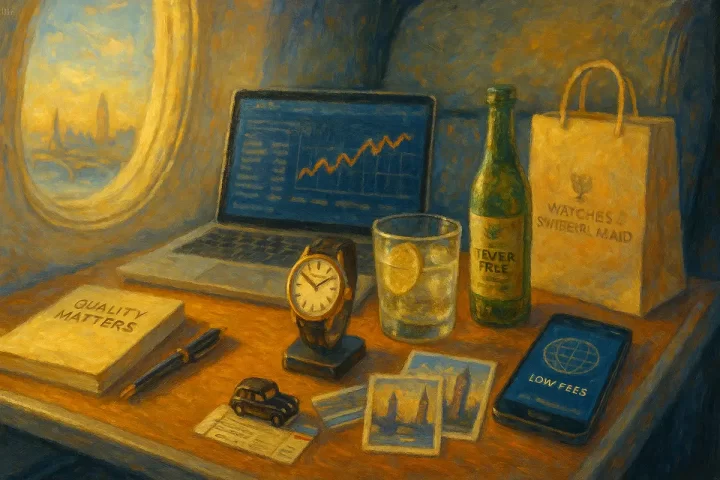
I’m writing this on the plane from London to Denver, not knowing where my subconscious will take me, but looking forward to the journey. Alright, the flight from London to Denver is ten hours, and thus this essay is on the longer side.
Technology Changed Paris… Kind of
On this trip, my wife and I visited Paris and London, where I spoke to CFA Societies in both cities.
The last time we visited Paris together was in 2000, when Rachel was pregnant with Jonah. We enjoyed Paris so much more this time than 25 years ago—not because Paris changed, but because technology has.
Back then we were young and broke, staying in a hotel a few miles from the city center. This was before the iPhone, GPS, and Uber. Taxis were expensive, the subway was confusing, and Parisians either didn’t speak English or didn’t want to help us with directions. Our French didn’t go beyond bonjour. I distinctly remember how frustrating Paris was.
This time we stayed in the center of Paris, but more importantly, we were armed with GPS and Uber. We no longer had to ask anyone for directions. Google Translate helped us navigate restaurant menus. When it rained or we were tired—we usually walked at least 10 miles a day—we’d just call an Uber. Like magic, a minute later the car would appear with our destination already preprogrammed.
The only change I noticed in Paris itself? Getting to the Eiffel Tower now requires going through security. That’s about it.
My Lady at the Musée
In Paris we visited our favorite museum in the world again—the Musée d’Orsay. I’ve been there five times. It has one of the best collections of Impressionists, on the fifth floor. We visited “my lady”—the portrait of Madame Rimsky-Korsakov by Franz Xaver Winterhalter. If her family name sounds familiar, it’s because she was the aunt of the famous Russian composer Nikolai Rimsky-Korsakov.

The very first time we were in Musée d’Orsay, I fell in love with this painting. There is something magical about this woman, and I keep coming back to see her every time I’m in Paris.
Two Hours Under the Channel
We took the Eurostar from Paris to London—two hours and twenty minutes of pure joy and calmness. I love trains, and this was a ten out of ten experience. My wife is a scaredy-cat, so I only told her afterward that we’d spent a good chunk of time underwater. The train goes under La Manche—what the French call it; the British call it the English Channel.
London now feels a bit like home. This was my second visit in three months. It grows on you.
The Knowledge vs. The App
It was my wife’s first time in London, and she insisted we take black cabs. We got a chance to talk to a lot of drivers, who are very chatty. To become a black cab driver, you need to pass the test presumptuously called “The Knowledge.” No, this is not a test for a PhD in world science, but in UK streets and landmarks. Cab drivers have to memorize about 50,000 streets and landmarks.
As you can imagine, in a world where GPS comes equipped with “The Knowledge” and readily available cheaper alternatives—Uber—exist, the demand for black cabs isn’t exactly hitting new highs. The number of black cabs has declined from over 22,000 a decade ago to around 15,000 today. “The Knowledge” academy only produced two graduates last month.
What really shocked me is that there are now over 110,000 Ubers roaming the streets of London. Uber is, in my experience, 40% cheaper, and you can call one from the app. Yes, cab drivers lost thousands of cabs to Uber, but the market for hailed cars expanded by 100,000 thanks to added convenience and lower prices.
By the way, there are still advantages to taking a black cab. After you spend three years accumulating “The Knowledge,” you’ve made a huge investment, and thus you’re hanging on to your black cab credentials for dear life. My pushback to this argument is that Uber drivers are rated as well—drivers with lower ratings have lower priority in getting rides. There are embedded incentives for them to treat passengers well.
But more importantly, black cabs are allowed to use bus lanes—in a city mired by constant traffic, this becomes an important benefit. We took a black cab regularly to navigate through traffic but took Uber to the airport (it was literally $70 cheaper).
The fact that you’re here, reading, thinking, reflecting with me, honestly means a lot. Every reader isn’t just a number; it’s a real person choosing to spend time with me, and that’s both humbling and energizing. If you’d like to keep exploring ideas about investing, life, and philosophy, or if you have questions or thoughts to share, come find me on X or Twitter or whatever we’re calling it now, at @vitaliyk. It’s where I’m most active and responsive.
The Price of Fairness
This time I visited three companies—Watches of Switzerland, Fever-Tree, and Wise. We’re shareholders in the first two.
Watches of Switzerland made me think more deeply about the UK. To paraphrase Churchill’s words about the US: The UK eventually makes the right decision after it exhausts every wrong one.
Starting with Brexit, the country has been a political mess. Two decades ago, the UK’s GDP per capita was much closer to the US’s. US real GDP per capita grew from $58,000 in 2004 to $75,500 in 2024, while the UK’s grew from $47,000 to just $52,500. The gap has more than doubled—from $11,000 to $23,000.
Recent legislative “victories” have been negatively impacting the country. In the quest for fairness, the UK started taxing its expats’ income earned outside the UK. The argument was simple: It’s only fair that they should pay taxes on all their income.
The result? Millionaires left the wet pond for the hot desert of Dubai, which offered a tax-free haven for foreign-earned income. The UK lost billions of pounds in tax revenue.
But this quest for fairness didn’t end there. The UK is now the only country in Europe that doesn’t return its value-added tax (VAT) to foreigners upon their exiting the country. It stopped doing so on January 1, 2021—the same day the UK exited Europe. VAT in the UK is 20%.
When this VAT law was passed in the name of fairness, the argument was that retirees pay VAT, so wealthy Arabs visiting the UK should, too.
When “wealthy Arabs” visit the UK and stumble upon a Watches of Switzerland store to buy a £10,000 Rolex, they quickly discover they can get it for £2,000 less across the Channel by taking a nice, comfortable Eurostar ride.
Yes, the rich—the Watches of Switzerlands of the world—took a small hit, but the mobile wealthy simply left for places that welcomed their capital. The have-nots absorbed the real damage: fewer sales, fewer jobs, lower incomes. The result? Retirees still pay VAT, wealthy Arabs shop in Paris, the UK loses billions in revenue, and the wealth gap this policy supposedly addressed only widened. The UK looks like a frog slowly boiling to death while turning up the heat on itself.
The UK keeps comparing itself to its wealthy cousin across the pond. They argue: Americans pay sales taxes (a consumption tax, similar to VAT), and they pay taxes on foreign income, too. But America isn’t a foggy island, and competition from the rest of Europe isn’t just a train ride away. We have our own problems, but at least our main attraction isn’t being a shopping destination for wealthy tourists and a tax haven for expats from other countries—and lately, unfortunately, not much else. A sad fact: In the pursuit of green energy, the UK has destroyed its fossil fuel energy infrastructure while spending billions subsidizing far more expensive “green” energy. Thus, its electricity costs four times more than in the US. As you can imagine, this isn’t conducive to manufacturing.
I could keep going with this, but my blood pressure is rising. I’ll keep my fingers crossed that our British friends have finally exhausted every wrong decision and are ready to make the right ones. Though I suspect my fingers will fall off first—plus it would be difficult to type this way.
Back to Watches of Switzerland. Its fundamental performance in the UK reflects the miserable economic climate and tax policy of the country—flat to slightly growing sales. If VAT tax reimbursement is reinstituted, this will be a positive catalyst for sales growth in the UK. Stoics would call it a “positive preference”—nice if it happens, but not the core of our investment case, which rests on the US.
The US represents about half of their revenues and has been growing nicely. Historically, luxury watches were sold by jewelers, and their presentation treated watches like commoditized diamonds. The company has been changing that. Their Rolex and Patek Philippe stores in Hudson Yards shopping mall in Manhattan are a great example of that—they are elevating these brands to art-level luxury (I’ll be visiting them on my trip in early December).
If Americans spent as much money on Swiss watches as our British friends, the demand would go up about 80%. It gets more interesting if you look at millionaires. Britain has around three million millionaires, America almost twenty-two million. Yet Swiss watch exports work out to roughly 500 Swiss francs a year per British millionaire and only about 200 francs per American one. In other words, even among the wealthy, the British buy Swiss watches at more than twice the intensity of Americans. Adjusting for the concentration of wealth, US consumption could increase 2.6 times. Again, at Watches of Switzerland’s current valuation, this upside remains a positive preference.
The amount of digital ink I’ve been spilling on Watches of Switzerland would make you believe that it is a huge position for IMA—it is not. But knowledge (not “The Knowledge”) is cumulative. I learn a lot from researching, really enjoy it, and position sizing is not set in stone. I’ve written a longer piece about it, which you can read here.
Fever-Tree
Before I explain why I love Fever-Tree as a product and an investment, here’s the story of how tonic water became a British obsession—it’ll make more sense after.
Picture this: it’s the 19th century, and malaria is wiping out British troops in hot, mosquito-infested colonies in India and West Africa. Scientists extract quinine from South American cinchona bark—voila, an anti-malaria miracle drug. The problem? Quinine dissolved in water tastes absolutely horrendous.
Enter the resourceful British officer class. They already have plenty of gin in their rations (because, well, they’re British). So they start mixing the daily quinine dose with water, sugar, lime, and a generous pour of gin. Suddenly the medicine doesn’t just go down; it goes down delightfully. The gin and tonic is born—not in a fancy London bar, but in a sweaty colonial outpost as a life-saving cocktail.
This is precisely why the G&T became a national institution in Britain and remains far more popular there than in the US. We Americans never had to choke down quinine to survive our nonexistent tropical empire.
Fast-forward to 2005. Two English guys, Charles Rolls and Tim Warrillow, frustrated that every tonic water tastes like chemical-laden sugar water, decide to go back to basics: real quinine from cinchona trees, natural botanicals, no artificial junk. They name their premium tonic Fever-Tree—a perfect nod to the tree that started it all.
I’ve been consuming so much G&T lately (more T than G to be honest) that I can travel to malaria-infested parts of Africa without a malaria vaccine.
Now, back to investing.
Fever-Tree keeps amazing me. I absolutely love the company’s obsession with quality. The company isn’t much different from Coke—it develops, sources, and markets the product but doesn’t manufacture it or own factories.
Schweppes, its biggest competitor in tonics and mixers, doesn’t have a single owner. The brand has different distributors with rights in different countries. Nobody is truly obsessed with it or cares about it the way Fever-Tree does. Like any other beverage company, Schweppes’s owners are just trying to figure out how to squeeze an extra penny out of production costs.
I heard a story about Schweppes ginger beer. One distributor wanted to reduce the cost of ginger, so they added chili sauce to give it a bite. But the lower ginger content reduced the murkiness of the water—a defining feature of ginger beer—so they added another chemical to restore it.
Fever-Tree, by contrast, has been importing three types of ginger from day one. It’s also been importing quinine—a core ingredient in tonic—from the same place in the Congo for over twenty years. In the deal Fever-Tree signed with Molson Coors, Molson Coors will distribute and manufacture the product, but it cannot touch the recipe. Fever-Tree maintains control. I respect that.
A friend told me he bought some good gin and stopped at Tesco to get Fever-Tree. The store was out of it, though they usually carry it. He couldn’t bring himself to buy Schweppes, so he went to a different store. That’s brand loyalty.
In Search of Excellence
I also had a chance to spend some time with Wise. I am a huge fan of the company. In the past I wrote that I admire management that has the ability to suffer. Wise management is the definition of this.
Wise has built a very innovative cross-border money transfer product. They provide great service, customers love the product and the prices, thus Wise spends almost no money on acquiring customers (they come through word of mouth, while competitors have to spend a good chunk of their revenue on customer acquisition, which puts competitors at a substantial cost disadvantage). In fact, the company’s product is so good that banks—who are supposed to be their competitors—are white-labeling Wise’s platform, using it for cross-border transfers while slapping their own name on it. Wise’s long-term goal is to become a platform for global money transfers.
But here is where it gets fascinating: Wise keeps lowering prices. As they grow—it’s a fixed-cost business—their margins expand. But instead of pocketing these expanding profits, Wise passes cost savings on to the customer by lowering transaction costs. This is why customers love Wise. This of course reduces the rate of the company’s earnings growth. And the management is fine with it. Two co-founders still own a big chunk of the company. Just to clarify, this is not altruism (though consumers definitely benefit from this), but cold logic and long-term thinking. By continually lowering prices they’re destroying their current and future competition, making it very difficult to get to scale —they are building an insurmountable moat. I really respect that.
We may or may not buy the stock—it’s on our watch list (we are looking for a better price). But, whether we buy it or not, I have benefited tremendously from studying this company. It showed me what excellent management looks like. Once you study companies like Wise, your tolerance for mediocre management declines.
I have a good friend who used to fish for stocks at the bottom of the barrel of quality and corporate management (he was seduced by statistical cheapness), and I think his latest returns have suffered for it. He recently bought Wise stock. I don’t know if he’ll make much money on the stock (I hope he does), as today’s stock price demands fairly high growth persisting for a long time. But I know the management quality of his future investments is going to be higher. I am very happy for him.
I’ve heard a saying that you are the average of your five closest friends. If you want to improve, you want to surround yourself with people who are better than you in certain parts of their lives, and spend less time with people who pull you down.
Avoiding bad influences is probably even more important because bad influence is more pervasive than good influence. If you spend a lot of time with heavy drinkers, you’ll likely drink more, etc.
Something similar happens in investing. If you spend a lot of time studying excellence, you’ll become a bit more allergic to mediocrity and the average caliber of your portfolio will go up.
However!!! This point is important: Investing, like life, is nuanced.
That means you can’t necessarily buy great companies run by terrific management at any price. The price (valuation) you pay is an important component of future returns. So buying quality at any price is foolish.
Today I am a different (hopefully better) investor than I was five, ten, twenty years ago. It would be sad if I were not. As I look at the biggest changes, it is my focus on quality. But not just business and balance sheet quality; no, the quality of the people who run the business. As I look at our portfolio today, the caliber of companies we own has risen.
The mantra I keep repeating to myself is: There are tens of thousands of stocks out there; I only need twenty-five. We can be extremely selective and uncompromising, especially when it comes to quality. Thus, when the market is going bananas over the latest obsession, we keep studying and building our watch list, filling it with exceptional companies that may not be undervalued today.
If you keep looking for new friends at dive bars, you’ll likely surround yourself with drunks. The same logic applies to portfolio construction—if you keep spending your time building a watch list of great businesses run by great people, eventually your portfolio will skew toward greatness.
Key takeaways
- Technology has made cities like Paris and London far more enjoyable to navigate, but beneath the convenience of GPS, Uber, and Google Translate, the real story is still about human experience and how we move through the world.
- London’s black cabs, “The Knowledge,” and the rise of Uber show how hard earned expertise can be disrupted by software, yet real advantages remain when you combine knowledge with structural benefits, like bus lane access.
- The UK’s quest for “fairness” in tax policy, from expat taxation to killing VAT refunds, is driving away mobile capital and tourists, hurting regular people far more than the wealthy visitors these policies were aimed at.
- Watches of Switzerland, Fever Tree, and Wise are case studies in how obsession with product quality, brand, and long term thinking creates moats that lazy competitors and financial engineers cannot replicate.
- I only need about twenty five stocks, which means I can be ruthlessly selective, surround myself with exceptional businesses run by excellent people, and let quality investing quietly reshape both my portfolio and my standards.












comments
0