
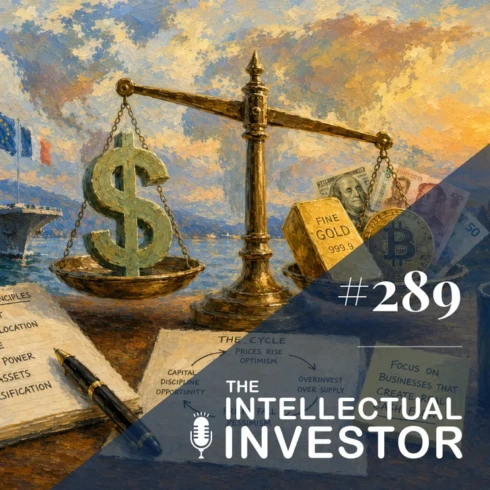
Questions answered in this episode
How has the war in Iran changed how you think about portfolio construction? The war highlighted a deeper shift in the post-WWII order, with the US weakening its own alliances and quietly handing China and Russia the gift of a fractured West. That makes the world less predictable, raises pressure on US deficits, and means real commodities are likely to cost more over time. Our response has been to stay comfortable with our oil and gas exposure, add to gold, and look for businesses in non-Western countries where the rule of law still holds.
Is the US dollar losing its status as the world’s reserve currency? Not in a binary, one-day-to-the-next way — but in billions of small incremental decisions. Vietnam settling a trade in yuan, India buying Middle Eastern oil in local currency, China and Russia trading in their own currencies — none of it is dramatic alone, but the trend is real. The dollar’s share of foreign reserves has already fallen from 70% to 58% over two decades, and that drift is likely to accelerate.
What’s the catch in being the world’s reserve currency? Reserve status spoiled us. Foreign demand for dollars subsidized our borrowing costs and made us feel invincible and fiscally untouchable, even as we drifted from exemplary borrower to drunken sailor. Governments that can print money don’t go bankrupt in the traditional sense — they go bankrupt slowly, by paying creditors back with currency that buys fewer eggs.
How do you think about owning oil companies, especially ones outside the US? The decision isn’t really about where a company is headquartered — it’s about the business, the assets, and above all the management. Oil is brutally cyclical, and average managers tend to invest at the top and dilute shareholders at the bottom, so we hunt for the rare operators who zig when the industry zags. We stick to Western democracies like Canada and Norway, where the rule of law is solid and governments are oil-friendly because they need the tax revenue.
Why own gold if it has no cash flows? Honestly, I hate owning it — gold violates most of my past-held beliefs. But currencies are stories, and gold’s story is five thousand years old, which matters when central banks are running out of alternatives. After the US froze Russian reserves and turned the dollar into a political weapon, central banks started accumulating gold at roughly double the pace of the prior decade, and we want a small position alongside that shift.
Should I put a little money into crypto as a lottery ticket? Bitcoin may have been a lottery ticket a decade ago, but today it’s institutionalized and widely owned — it has been discovered, and lottery-like returns are unlikely from here. I won’t buy it in client accounts; I only have room for one purchase I hate, and that’s gold. If you want to own some personally, only put in what you’re willing to lose — and you don’t need us for that.
📩 Join 100,000+ readers on my FREE weekly email newsletter: https://investor.fm/sign-up/
Trump’s call for a bitcoin strategic reserve is a very bad idea article: https://investor.fm/trumps-call-for-a-bitcoin-strategic-reserve-is-a-very-bad-idea/
📚 Get my books:
Soul in the Game – https://amzn.to/43CF73v
The Little Book of Sideways Markets – https://amzn.to/3QWTlqZ
Active Value Investing – https://amzn.to/3u8zn3A
WHO AM I: Vitaliy Katsenelson is the CEO of Investment Management Associates (IMA) in 2012. Forbes Magazine called him “The New Benjamin Graham.” He’s written for publications including Financial Times, Barron’s, Institutional Investor, and Foreign Policy.













comments
0