
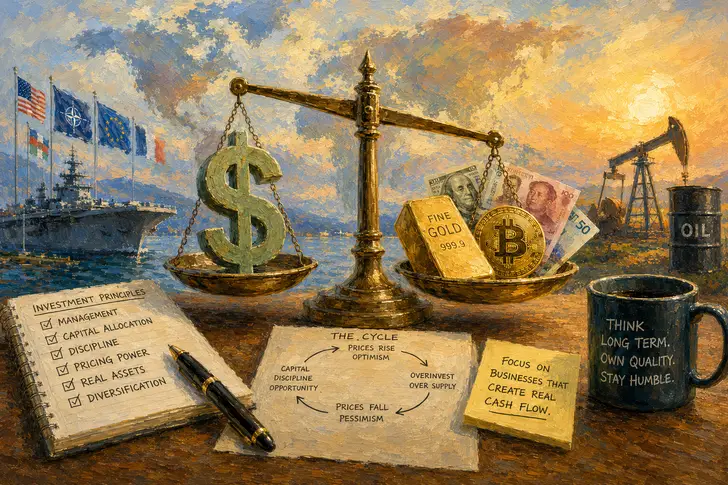
How has the war in Iran impacted your thinking on portfolio construction or the investment process?
It is hard to answer this question fully, because the war is still ongoing. Even if as of this writing no shots have been fired for a few weeks, that may change by the time you read this.
From a long-term perspective, this war highlighted a change in the post-WWII order. The United States has been the main catalyst for this change.
Europe and the US were unquestionably closest allies. Today this alliance has been put into question. China and Russia (which are “just holding the beer” while this relationship that was cemented in blood during WWII is being destroyed) are the biggest beneficiaries of this rift, not the US or Europe. Both are weakened by this change.
The US is also becoming less predictable. An important part of US strength lay in its soft power and being at the center of important alliances.
Let me give you a simple illustrative example. The US is able to project military power not only by having a strong military but also by having access to 800 bases in other parts of the world. These bases give us landing strips and supply depots. They magnify our military strength. As relationships with our partners weaken, we will lose the ability to use these bases, and thus our ability to project military power will lessen as well.
Now apply this analogy to the economy. The US has been both a beneficiary and a casualty of the dollar being the world’s reserve currency. It is a casualty because inflows into the US dollar have been artificially driven by foreigners using it as a store of value, and thus US-made goods were less competitive globally. This in part drove our focus on, and exports of, services, knowledge, and highly differentiated, sophisticated products (think software, planes). And in part this allowed China to become a manufacturing powerhouse.
We were also a significant beneficiary, as foreigners parking their money in the US dollar (our Treasury bonds) subsidized one of the most important commodities in the world: money. Our borrowing costs were artificially lower despite the US transforming from an exemplary borrower to a drunken sailor who is spending 6% more than he earns, which in the past only happened during wars.
The Iran war, if it continues, is only going to make deficits go higher. And god forbid we ever see a recession, it will spike to, I don’t know, 9% or higher? The US government will never go bankrupt, at least not in a traditional sense of suddenly not being able to pay its creditors. Governments that can print money go bankrupt by printing money. They go bankrupt very slowly through inflation, by paying their creditors back with currency that buys fewer eggs and barrels of oil.
I have complex feelings even about the “benefits” part of the US having the reserve currency. I think it has spoiled us, made us feel invincible and less fiscally responsible. We got used to thinking we were “exceptional.”
However, our exceptionality was not a gift from the economic gods; it was partially gifted to us by Lady Luck. We have great geography. On the left and right we are surrounded by oceans, on top and bottom by peaceful (if irritated) neighbors, and we are chock-full of natural resources. The earned part was our constitution and democracy, which gave us the rule of law, predictability (incredibly important feature of capital markets), and capitalism. Free markets, which fostered innovation and allowed the human spirit of ingenuity to flourish.
The obvious casualty of weakened alliances and the US losing soft power is the US dollar. When we look at our reserve currency, our minds lead us to think in binary terms: yes or no. And maybe in the past it was a binary choice, because it was such an obvious choice. Not today. The US dollar’s attractiveness is likely declining. That doesn’t mean that tomorrow trade between Canada and the Philippines will be done in Russian rubles or Chinese yuan. No.
But think of it as billions of little incremental decisions.
Vietnam selling shoes to Brazil, and instead of parking money in dollars, putting some of it in Chinese yuan because it was going to buy rubber inserts from China anyway. Or oil, one of the largest real commodities, that in the past was settled in dollars and is now settled in local currencies, again driving lower demand for the US dollar. India is already buying oil in the Middle East in local currency. China and Russia are now trading in their local currencies.
The tricky part of this discussion is that currencies are a relative game. The European economy and its power are arguably declining at a faster rate than the US’s, and thus the dollar being less of a reserve currency doesn’t automatically mean that the euro will spike. The euro will likely benefit (it already has) purely from not being the US dollar.
However, don’t misread this as my excitement for what is taking place in Western Europe.
I have written in the past how painful it is for me to watch the decay of Europe: the increase of regulation and socialism, which leads to the erosion of common sense, productivity, and business formation. I don’t like writing on these topics because they truly depress me. Writing about the US is not much fun, either.
But anyway. The US dollar is likely going to be less of a reserve currency than it was five or twenty years ago. That is not a new development. Today the dollar accounts for 58% of foreign currency reserves, down from 70% two decades ago. We are likely going to see an acceleration of this trend. What does it mean? Real commodities are likely going to cost more.
We are happy with our commodity exposure to oil and natural gas (at least in the short to medium term). We added to our gold position (I’ll discuss this later in the letter). If we can find good businesses in the real-commodity space run by exceptional management at attractive prices, we would love to increase our exposure to this part of the economy. In the meantime we are looking to diversify our exposure to other non-Western countries.
I am curious how you think through the complexity surrounding a non-US oil producer’s stock.
We own a Canadian oil company with most of its assets in Canada, a Swedish one with most of its assets in Canada, and a Norwegian one with all assets in Norway. (This may vary slightly from account to account.) In each case, the decision to buy was not driven by where the company is headquartered but by the business, and most importantly, by the management. (They were all undervalued, that goes without saying.)
The location of assets was of course an important part of the analysis, but Canada and Norway are not high-risk areas. Both countries rely heavily on taxes from the oil industry to finance their vast social programs, and thus they have been oil-industry-friendly.
At the core of our decision to own these companies was management. The oil business is very cyclical. Fortunes are made or destroyed not just by how well companies drill holes or squeeze oil out of rock, but by capital allocation. Oil companies, and this applies to mining companies too, are run by eternal optimists, and we should thank them for it. In dire times, when oil prices are kissing the ground, they are optimistic that prices will rebound, and so they don’t quit. When oil prices make new highs, they believe their prayers have been answered, that the prophecy of permanently high oil prices is finally here. And this is what usually gets them in trouble: They keep investing. This of course leads to higher supply, and eventually the cycle continues. Oil prices decline.
We should thank oil men and women. Their ingenuity has led to massive increases in production and remarkable innovation. The US produces a lot more oil today with far fewer rigs, and we literally squeeze oil out of rock. The industry has been vilified over the last decade, but the US’s large internal production of oil and natural gas is a significant source of our national security. Europe, on the other hand, due to its insane “green” policies, is importing oil and natural gas and today is even talking about grounding planes.
But though these oil folks are good for society, they may not be good for your portfolio, because they tend to buy (invest) at the top and are often forced to sell (dilute shareholders) at the bottom.
While average management can do fine in a stable, noncyclical industry, average management will disappoint, and likely destroy capital, in a highly cyclical one. So in highly cyclical industries, we are hyper-focused on finding the best of the best. These managers zig when the traditional oil executive zags. They do the very hard thing: They sit on their hands when oil prices are going to the moon, or, even better, they raise capital. And they are prepared to buy on the cheap when oil appears to be meeting its maker, the extinct dinosaurs.
This is why we chose the companies in our portfolio. Our appetite for exotic geographies, where the rule of law is scarce, is very low, which is why we stick to Western democracies.
Is it wrong to think of putting a tiny amount into crypto, with the idea that it could explode orders of magnitude to the upside, or go to zero, much like buying a bunch of lottery tickets?
My views on crypto have changed because the facts changed. Our government embracing and legitimizing crypto, and then the president issuing his own “shit coins” (a technical term invented by the crypto industry), was not on my bingo card.
I have written about why this goes against our national interest: A country that has a near-monopoly on the global reserve currency but relies on the kindness of strangers to finance its huge budget deficits should not be institutionalizing its competitor.
In all honesty, I have lost some intellectual ground here, because we (and this includes me) own gold. Gold, just like crypto, violates all my past-held beliefs. It has no cash flows, and thus I have no idea what it is worth. The difference is that crypto is not quite two decades old, while gold has a five-thousand-year history. This matters, because currencies are stories, and the more socially accepted the story, the more we buy into the currency’s legitimacy.
We own a small position in gold, and I absolutely hate it. But to me it makes sense, because people and central banks are running out of alternatives. The US government’s freezing of roughly $300 billion of Russian central bank reserves turned the dollar into a political weapon and undermined the comfort countries (even adversaries) had in it. Central banks are now accumulating gold as if preparing for an Indian wedding (Indians consume the most gold for jewelry, 563 tons in 2024, surpassing China). Central banks have bought roughly double the amount of gold over the last few years compared to the prior decade.
Despite this, our excursion into gold is a very small part of our portfolio. Our focus will continue to be on stocks of companies with pricing power, or whose revenues are tied to someone else’s revenues. These are the most commonsensical cash-producing alternatives in an environment where all Western governments are destroying their currencies by making, and fulfilling, promises they cannot afford.
I’d only put as much money into crypto as you are willing to lose. Bitcoin makes more sense today than it did two years ago. I won’t be buying it in client accounts. I only have room for one purchase that I hate.
I may have answered a question you didn’t ask. I do this from time to time. So let me answer the question you did ask. Bitcoin may have been a lottery ticket a decade ago; today it is hardly one. It is institutionalized and owned by the masses. In other words, it has been discovered. I have no idea what it will do going forward, but lottery-like returns are unlikely (though crazier things have happened). If you decide to buy it, you don’t need us for that.
If there is a thread running through all three answers, it is this: the rules that made the US exceptional are quietly being rewritten, and the dollar, oil, and gold are all reacting to the same underlying shift. Our response is not to panic or to make heroic predictions. It is to own businesses with pricing power, run by managers who think clearly when everyone else is not, in places where the rule of law still holds, bought at prices that give us a margin of safety. The rest, as always, takes care of itself over time.
Key takeaways
- The post-WWII order is being quietly rewritten, and Russia and China are the beneficiaries. The US-Europe alliance, cemented in blood, is being put into question — and both sides come out weaker, while Russia and China are “just holding the beer.”
- US exceptionalism was part earned, part gifted by Lady Luck. Great geography, peaceful neighbors, and natural resources were the gift. The constitution, rule of law, and capitalism were the earned part. Reserve currency status spoiled us into feeling invincible and fiscally irresponsible.
- The dollar’s decline as reserve currency isn’t binary, it’s billions of incremental decisions. Vietnam parking some money in yuan, India buying Middle East oil in local currency, China and Russia trading in their own currencies. The dollar is already down from 70% to 58% of foreign reserves over two decades, and that trend is accelerating. Real commodities are likely going to cost more.
- In cyclical industries, average management destroys capital — only the best of the best will do. Oil executives are eternal optimists who buy at the top and dilute at the bottom. We thank them for society’s sake, but for portfolios we want managers who zig when others zag — sitting on their hands at the highs and buying when oil is meeting its maker.
- Gold makes sense to me even though I hate it; crypto does not earn a spot in client accounts. Central banks are accumulating gold as if preparing for an Indian wedding, because the US weaponized the dollar by freezing Russian reserves. Gold has 5,000 years of story; crypto has two decades. Bitcoin has been discovered — it is no longer a lottery ticket. I only have room for one purchase I hate.
- The response isn’t panic or heroic predictions. Own businesses with pricing power, run by managers who think clearly when everyone else is not, in places where the rule of law still holds, bought with a margin of safety. The rest takes care of itself over time.












comments
0