
I’ve been attending the Berkshire Hathaway annual meeting for more than 15 years. When people ask what it’s like, I always struggle to describe these three days in Omaha — a small city invaded by 50,000 people from all over the world, all there to hear the words of the Oracle of Omaha, Warren Buffett. It never gets old.
For those heading to Omaha for the first time — or coming back for the nth time — I’ve put together a simple guide to this wonderful weekend, written entirely from my own experience.
A few things I’m involved in this year:
Our Q&A breakfast moves to Sunday morning this year. It’s completely free — but last year we hit capacity and had to turn people away, so don’t wait. We’ll also have a lineup of well-known authors signing books at the event. Grab your spot now before it fills up.
On Saturday, I’ll be hosting a fireside chat with Adam Anderson, CEO of Innovex, the oilfield services company we own. A few months ago I told Adam how much I love BRK weekend — apparently I was so convincing that he decided to come. I’ll be interviewing him about Innovex, the oil services industry, capital allocation, and more. I’ve never done this before and I’m really looking forward to it!
On Friday, I’ll be a panelist at the Creighton Value Panel. And if you’re a YPO member, join us Saturday at the YPO event hosted by the local chapter.
I put all the details — restaurants, hotel tips, my schedule of events, and a few things most first-timers miss — into one guide. Whether it’s your first trip or your tenth, there’s something in here for you.
Check out my Omaha weekend guide
When to sell a stock: The Art and Psychology of Selling
This article is an excerpt from the winter letter I wrote to IMA clients.
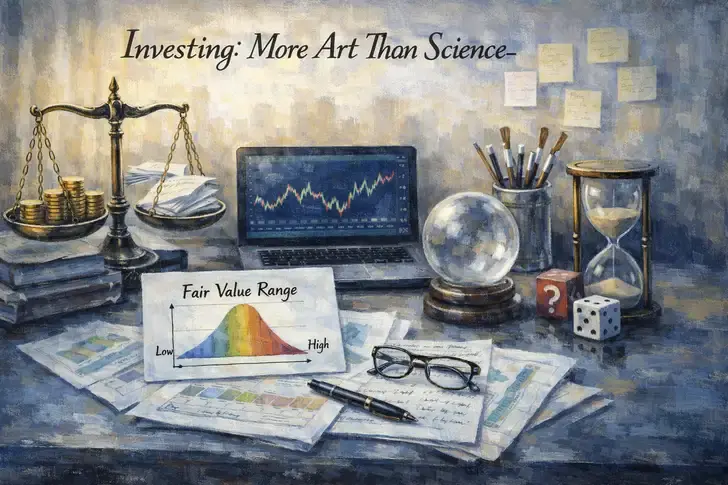
I have to confess, this whole investing thing is a lot more art than science. I bring a scientist’s mindset – I approach problems with an open mind and I am willing to change my mind when data proves me wrong. But the world is constantly in flux, and I have imperfect, incomplete, constantly changing data, with new data pouring in daily. Though for every single company we have fair value and rate of return numbers on our spreadsheet, in our mind those numbers are vague, directional approximations. A company’s fair value is a range of values, which may change as facts and our view of the future change.
I devoted chapters to our sell discipline in my first two books. I’d probably rewrite those chapters, as my thinking about selling has evolved over the years. I’ve learned new things from my successes and my failures (I’ve had plenty of those).
I am more patient with selling when a lot of things are humming together and impatient when I lose confidence in management, and I have zero tolerance when I have an iota of doubt about management’s character.
Today, I also think a lot more about position sizes – they express our confidence about future returns, the range and skewness of outcomes. The higher the quality of the business and the better our understanding of it, the larger a position size we are willing to tolerate in the portfolio.
Valuation of course plays an important part, too, but it used to be front and center; now it is just a significant component in the mix. We let Babcock, for instance, grow much bigger than Vitaliy the book author would have before we started trimming it. There was a lollapalooza of positive factors: irreplaceable assets (the only place in the UK that can refuel and fix submarines), one of the best management teams in the world, and the tailwind of defense spending globally. As operating performance improved, the UK government trusted it with more contracts.
But psychology is just as important as the analysis.
We would have been better off if we had not sold a share of McKesson – the stock is up 7x from our first purchase. But that is almost impractical; it would be 40% of the portfolio and you and I would lose sleep over it. If one of us loses sleep over it, it means the cost of being wrong is too high and thus the gain is not worth it.
I was patient with trimming McKesson – the best player in the industry in a growing, very stable industry, with significant demographic tailwinds, A+ management. Vitaliy – the author of my first two books – would have sold it much sooner. We still own remnants of it.
The new me is more nuanced about selling, and it is harder to put that into a rigid framework, as each position is really a case-by-case analysis – this is why it is more art than science.
I am probably going to be more patient with Philip Morris (PM) than with British American Tobacco (BTI). PM has an exceptional management team with incredible ability to suffer, to sacrifice short-term returns for long-term competitive advantage. But BTI has been gradually improving; and thus over time, as I have greater confidence in its management, I may give it a longer leash.
I am writing all this to explain that there is a process to selling, but it is not rigid and is always in flux and full of… yes, humility.
If you take one thing from this letter, let it be this: don’t be afraid to evolve your process. The Vitaliy who wrote those chapters fifteen years ago was doing his best with what he knew. The Vitaliy writing this today has made enough mistakes to know that rigid rules are comforting but costly. The best selling discipline is one that adapts — to the company, to the market, and to what you’ve learned since the last time you were sure you were right.













0 comments
0