
Over the last few years, going to the BRK annual meeting has turned from something I do with friends into a family tradition, as both of my older kids, Jonah and Hannah, come with me to Omaha. Attendance this year was down considerably. In the past, getting a restaurant reservation was an ordeal; this time around, restaurants were only half full. Attendance at the event itself was probably down by about half from last year’s 40,000.
The decline was not just driven by Buffett stepping down. A lot of international travelers did not come this year. Canadians are upset at the US over being belittled. I don’t blame them. Europeans are upset about our president’s comments on Greenland. I don’t blame them, either. This is what I heard from my Canadian and European friends who decided not to come to Omaha (or to the conference my company hosts in Vail).
The BRK annual event is unlikely to draw 40,000 crowds ever again, but diehard value investors will keep coming back. As I have mentioned dozens of times before, this weekend stopped being about Buffett or Munger the year you could watch the meeting on TV from the comfort of your couch. It is about people with similar values getting together, trying to learn from each other, sharing a meal, and celebrating the best of what capitalism has to offer: You can become anything you want if you really put your mind to it and focus.
I hosted three Jeffersonian dinners this year. What is a Jeffersonian dinner? The format goes back to Thomas Jefferson, who hated the way large dinner parties fragmented into shallow side conversations. So he designed an alternative: a dozen people at one table, one carefully chosen topic, and one conversation that everyone participates in. No side chatter, no breaking off into pairs. Everyone listens, everyone contributes, and the conversation goes deep instead of wide. These dinners have become annual events for me in Omaha.
This year I did something I had never done before: I interviewed Adam Anderson, the CEO of Innovex (a company whose shares we hold), in front of an audience. Our fireside chat was not recorded, but an attendee shared an AI-generated summary. You can read it here.
My reader get-together has grown from half a dozen of us meeting in a hotel lobby sixteen years ago to about 800 people coming for a Sunday breakfast Q&A in the Marriott ballroom. I am very humbled and, to be honest, still struggling with impostor syndrome. I was pleased that we had almost a dozen book authors, some of them friends, selling and signing books around the event. This is going to become an annual tradition: Sunday morning breakfast. If you are in Omaha next year, mark your calendar. You can register for next year here (make sure to tell your friends).
The event was recorded, and I’ll share the video next week.
Today I am going to share my thoughts on BRK’s new CEO, Greg Abel, which were published in Fortune.
Is Greg Abel Able?
Why BRK’s new CEO is a better fit than Buffett today.
Last year I came out of the BRK annual meeting thinking that Greg Abel was not the right person to run Berkshire Hathaway. Abel lacked Buffett’s charisma, warmth, and humor. I remember telling a friend that listening to him at the annual meeting was like listening to another consultant-turned-executive: proper, boring, with a very narrow corporate-speak vocabulary. Greg Abel was not Buffett, and he definitely was not Munger.
I was wrong.
Greg Abel is the right CEO for today’s BRK. Actually, a better person for BRK today than Buffett would be. My thinking changed when I started thinking about Tim Cook, who recently announced his retirement from the CEO position at Apple.
Tim Cook is no Steve Jobs. But there is no other Steve Jobs. The probability of another Steve Jobs replacing Steve Jobs was nearly zero. As I look at Tim Cook’s tenure, I can see that if he and Steve had run Apple together, the company could have been a lot more successful. Tim, as Jobs himself described him, “is not a product guy,” and so he failed to come up with another product of the iPhone’s magnitude. The Apple Car, which could have been that product, was a giant failure with several changes of direction and eventual disbandment. Apple Vision Pro felt half-baked. I’m not sure Steve Jobs would ever have released it. Siri, revolutionary when it launched on the iPhone, today has the IQ of a toaster compared to other AI models. Apple just settled a class-action lawsuit for exaggerating the AI capabilities of its newest iPhones (Elon Musk-like behavior).
And yet, Tim Cook did an incredible job running Apple. Through small, incremental improvements, he cemented the iPhone as an indispensable device. In the Jobs era, the Apple ecosystem was its biggest competitive advantage; Cook doubled down on it, with all devices working seamlessly together. He extended Apple’s software advantage into hardware, abandoning Intel for in-house M chips, which power MacBooks with multiples of the battery life of the Intel processors they replaced, without sacrificing performance. Apple is no longer the most creative company in Silicon Valley, but everything works. Apple’s revenues are up nearly 4x since Jobs passed away.
I remember reading in Walter Isaacson’s biography of Steve Jobs that Jobs’s advice to Cook (paraphrasing) was: Don’t ask what Steve would do. Do you. That’s exactly what the people running Disney did not do after Walt Disney passed away and they almost ran the company into the ground.
Steve Jobs passed away at a young age. If he and Tim had worked together for another fifteen years, Apple likely would have been even more successful, but it would have required both Steve and Tim. Of course, the problem with this kind of thought exercise is that we’re guessing at what alternate historical paths would have looked like. I’d argue that if we had to choose between Jobs’s creativity and vision and Cook’s ability to run an insanely complex supply chain and manufacturing operation, Cook was more important to Apple than Jobs at the time of Jobs’s passing. And then again, talent like Jobs’s is almost irreplicable, while Cook’s talent is much easier to replicate (corporate America has plenty of Cooks).
Companies need different CEOs at different stages of their lives, because they’re solving for different problems. This brings me back to BRK.
If you look at BRK today, you have GEICO, a consumer auto insurer; the reinsurance operations run for decades brilliantly by Ajit Jain, who just announced who will replace him in his retirement, which will come sooner rather than later; BNSF, one of the largest railroads in the country; a collection of other operating businesses; a portfolio of marketable securities (Apple, Coke, Amex, etc.); and roughly $400 billion of cash.
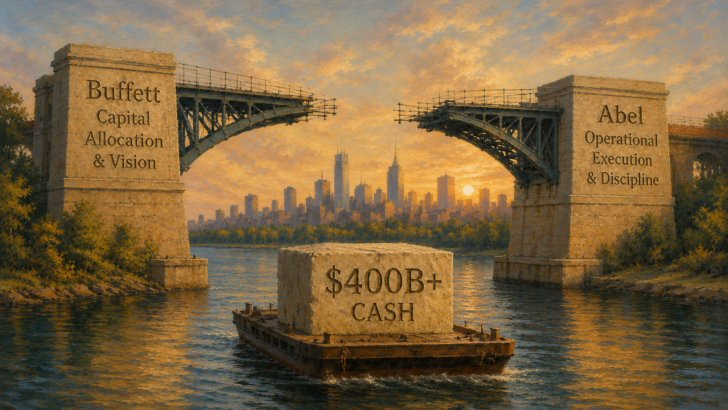
BRK requires three skill sets today. The first is replacing Ajit Jain, who will be very difficult to replace. The new CEO’s job is to make sure the right people are running that business. The second is running the rest of the BRK portfolio of private companies, and this is where BRK needs the most help. Buffett was never a traditional CEO. He loved investing (capital allocation), not managing people, and he avoided conflict at all costs. He bought businesses, let managers run them, collected the cash flows, and reinvested them. Today BRK has a collection of more than 100 operating businesses. BNSF and GEICO are the ones that matter most, and both have become hallmarks of mediocrity.
GEICO is being beaten up by Progressive, which is eating its lunch for breakfast, lunch, and dinner. Progressive overtook GEICO as the second-largest U.S. auto insurer; while GEICO was investing in marketing, Progressive was investing in technology, and GEICO is now stuck with hundreds of legacy IT systems while Progressive can reprice almost daily. Meanwhile, BNSF is one of the most undermanaged and least profitable Class I railroads in the U.S.
Buffett famously said you want to own businesses an idiot can run, because someday one will. Both GEICO and BNSF have substantial moats and have survived undermanagement, but I’d argue Buffett’s statement is less true today than it was decades ago. The half-life of a moat is shrinking much faster in the age of AI.
As an analyst I can look at BNSF and GEICO numbers and see they are being undermanaged. As a consumer I can observe that Dairy Queen, a company BRK bought in the late ’90s, has been substantially mismanaged. DQ is a beautiful business: Most of its stores are franchised, so they require no capital. Under the right management it could have tripled in size, just like Starbucks. The quality of its ice cream has not changed, but the innovation in food and the look of the restaurants have declined under BRK ownership. Every store I’ve visited looks like it’s run by a mom and pop, with boxes and supplies visible everywhere—everything other than the ice cream is quite awful. But instead of micromanaging DQ (or BNSF, or GEICO), Buffett had more important decisions to make, like buying Apple or the Japanese trading conglomerates.
BRK has reached a size where, absent a real financial dislocation, capital allocation is unlikely to be the source of forward returns. The low-hanging fruit is improving the performance of BRK’s core holdings, and maybe even shedding companies that shouldn’t be in the BRK portfolio. Greg, a billionaire and a large shareholder of BRK, has proven to be a shrewd operator of BRK’s energy business. Choosing Greg is one of the most important decisions Buffett made in decades. At the last annual meeting, we could see why. A corporate Mr. Fix-It is walking through every business, identifying key performance indicators, installing the right incentives, bringing technology to them, and replacing managers who need replacing. Doing things Buffett could not and would not do, but that need to be done.
Abel is not Buffett, and that is okay. In fact, it is a good thing. Greg Abel will not draw 40,000 people to Omaha for the annual meeting, though I’d bet that for so many of us it’s become enough of a tradition that 10,000 will still come. But he’ll make the difficult decisions Buffett didn’t want to make. He’ll make the trains run on time, literally and figuratively.
Key takeaways
- Attendance at the BRK annual meeting was down by roughly half this year, partly because Buffett is stepping down and partly because many of my Canadian and European friends decided not to come — and frankly, given our president’s comments about Greenland and the way Canadians have been belittled, I don’t blame them.
- I changed my mind about Greg Abel as Berkshire Hathaway CEO. Companies need different leaders at different stages of their lives, and the Tim Cook–Steve Jobs comparison helped me see that BRK today needs an operator more than it needs another Buffett.
- Capital allocation is no longer where BRK’s forward returns are going to come from. At this size, and with roughly $400 billion in cash, the low-hanging fruit is fixing the operating businesses — not finding the next Apple-sized investment.
- GEICO is getting eaten alive by Progressive, BNSF is one of the most undermanaged Class I railroads in the country, and Dairy Queen has been quietly mismanaged for years. Buffett’s old line about owning businesses an idiot can run matters less in the age of AI, because the half-life of a moat is shrinking fast.
- Greg Abel is the corporate Mr. Fix-It that Buffett never was and never wanted to be. He’ll walk through every business, install the right KPIs and incentives, replace managers who need replacing, and make the trains run on time — literally and figuratively.













comments
0