
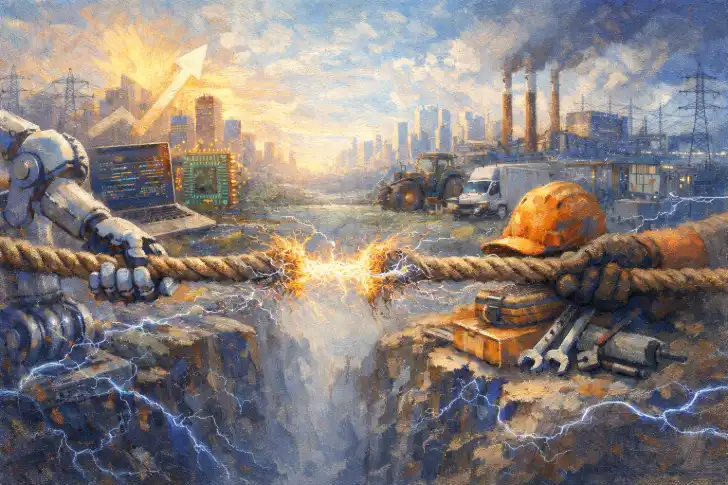
There’s an unwritten rule in media: the more uncertain the future and the more confident the predictions, the more clicks and views they get. AI’s impact on the economy is the perfect example. I hear predictions that AI will accelerate GDP growth to 7–10%, or that our economy will fall into an abyss, as if either is a foregone conclusion.
Instead of joining the chorus of false certainty, let me offer you a crayon-level framework for thinking about it. I am going for vaguely right, not precisely wrong.
You can explain economic growth with a simple formula: growth in the employed population plus productivity growth. When women entered the workforce in the 1960s and ’70s, the employed population surged and the economy expanded faster than population growth alone would predict. I saw estimates that today’s economy would be about 13% smaller if women had not entered the workforce.
On the productivity side, technology has historically added another 1–2% to GDP growth, as workers swapped hand tools for power tools, donkeys for combines, and adding machines for computers.
Now enter AI. Clearly a massive productivity tool. But productivity is only half the formula. Employment, and more importantly income from employment, is the other half — and that’s where things get complicated.
Take the software industry as an extremely crude example. It’s on the tip of the spear of AI disruption today. Say a company employs a team of developers. AI makes each one dramatically more productive. The company can now produce far more software than before.
In the best case, the higher output is absorbed by insatiable, newly created demand: The company can now write software for tiny niches it couldn’t reach before. This increases the productivity of the whole economy, demand rises, and all the developers keep their jobs while creating a lot of value.
There are also other, less rosy and no less likely scenarios. Demand doesn’t change, and the company lays off most of its developers because it only needs a fraction of them. Or maybe demand goes up but not enough to match the productivity gains, and the company still lays off developers because the remaining ones produce more than enough.
In both cases, developers are let go due to efficiency brought by AI.
Now zoom out.
The economy is a complex adaptive system, and what’s true for one company isn’t necessarily true at scale, for thousands of companies. A mix of the last two scenarios is the more likely outcome for the economy as a whole, and the consequences ripple outward. At the macro level, there is a tug of war between two opposing forces.
On the optimistic side, if AI helps companies create software they couldn’t have created before — whether more sophisticated or serving more niche markets — the pie gets bigger. Software that was previously too expensive to build becomes viable. New markets appear. Lower costs lead to lower prices, which improve the cost of living and spur demand. New demand creates new jobs.
On the darker side, fewer developers means companies spend less with software vendors: Oracle, Workday, Salesforce. Good for a software-producing company’s bottom line, bad for those vendors’ revenue and the employees who work for them. And if those vendors were buying this company’s software, that lost revenue flows back as lower demand. The laid-off developers themselves spend less and pay less in taxes. Apply this across an industry and an economy and suddenly you’ve got a shrinking pie.
So which side wins the tug of war? Nobody knows, and it will likely vary by industry.
The most common counterargument — the one I hope plays out and one I used to make myself — is that we’ve been through something like this before. A century ago, a third of the country worked in agriculture. Today, thanks to automation, a tiny percentage of the US population doesn’t just feed the country but much of the rest of the world. Farmers retrained; their children went on to build cars; and their great-grandchildren are doing jobs that didn’t even exist a decade or two ago: social media influencers, app developers, and the like. The economy adapted. It always has.
But here’s my hesitation with that analogy. Farmers didn’t retrain overnight. It took generations.
Today, the speed of change is unprecedented. It’s AI creating new AI. Each generation accelerates the next. Reportedly, 90% of Anthropic’s Claude Code was written by Claude Code itself. What used to take decades now takes years, often months.
The breadth is staggering. It started with software engineers, but it won’t end there. It will spread across all knowledge work — it is going to impact the previously untouchable professions, the Jewish mother’s dream jobs for her kid: lawyers and doctors — and then beyond. There are over four million Uber and truck drivers in the US, and self-driving is coming for them. Robots are already quietly taking over distribution centers and will eventually build houses, collect trash, and pick tomatoes — many of the jobs we Americans don’t want to do.
Put speed and breadth together and it’s very possible we’ll find a generation of workers whose skills simply don’t match the available jobs. That’s the real danger: not that the economy won’t adapt, but that it won’t adapt fast enough.
The software industry, the one grabbing headlines today, may be an aberration. Software engineers’ most important skill was thinking like a computer, and AI, being a computer, is faster and possibly better at it. Also, it doesn’t need to pick up kids from school, take vacations – it can work 24/7 in any weather. Other industries may not be as vulnerable as software, at least not as quickly.
Human inertia is a powerful force, especially in large companies. AI may end up moving at the speed of humans, as adoption has to overcome the default human behavior of resistance to change, fear for job security, and simply fear of the unknown. Self-preservation bias will slow things down considerably.
And there’s a physical constraint. Humans are energy: a mixture of food, water, Ozempic, and Viagra. AI is energy too: electricity. We are replacing one form of energy with another. AI may be displacing people in the workplace but not out of existence. Writing code to replace those programmers costs a lot of electricity, and building the new AI- and robot-powered economy requires data centers, factories, power plants, and grids. Those take years to construct. Energy is going to be a significant constraint to disruption.
The counteracting force here is competition. If more aggressive competitors start breaking progress at human speed — aggressively adopting AI, laying off employees, cutting costs, and lowering prices — competitors moving at human speed will have to adapt or die. The stock market will reward those who move at AI speed. Block (formerly known as Square), a fintech company, announced that AI had improved its efficiency and it will be (going full GPU), laying off 40% of its 10,000 workforce. Investors smelled much higher earnings — the stock instantly went up 20%. If you are a CEO worrying about your future, you were just shown a road map to a higher stock price.
New markets, new industries, new roles will emerge. They always do. But will they emerge fast enough? The adaptive system still works. The question is whether it can keep up.
At the end of the day, it’s really a tug of war between productivity and employment. As investors, we need to arm ourselves with a healthy dose of humility. The range of outcomes for how the future will look is getting wider, not narrower.
Key takeaways
- My simple formula for growth is being tested: I look at economic growth as simply employment plus productivity. While I see AI as a massive productivity tool, its impact on the employment side of the equation—specifically whether displaced workers can find new roles—is incredibly complicated.
- I see a macro-level tug-of-war: It’s entirely possible that AI expands our economic pie by making previously expensive software and services viable. However, I also worry about the darker scenario where massive layoffs lead to reduced spending and lower tax revenues, ultimately shrinking the pie.
- The speed of change is my biggest fear: When people tell me “the economy always adapts,” my hesitation is that past revolutions took generations. AI is moving at an unprecedented pace—AI is literally creating new AI—and I fear we’ll end up with a generation of workers who simply cannot adapt fast enough.
- Human inertia and energy are the only brakes: I believe the natural human resistance to change and the massive physical energy constraints (like building power plants and data centers) will slow AI down. But make no mistake—if a competitor starts moving at “AI speed” to cut costs and boost their stock price, others will be forced to adapt or die.
- My takeaway as an investor: At the end of the day, nobody knows exactly how this tug-of-war between productivity and employment will play out. I believe we need to arm ourselves with a heavy dose of humility, because the range of outcomes for our future is only getting wider, not narrower.












0 comments
0