
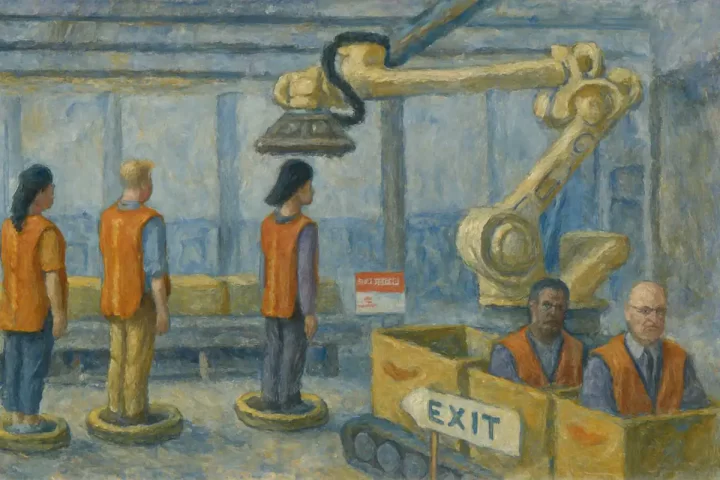
Today I want to share with you an article I wrote for The Wall Street Journal. The version they published — which you can read here — was edited for print space, so I’m sharing the full piece with you.
The Robots That Handle Your Amazon Orders
A visit to a fulfillment center, where machines move merchandise and tell humans what to do with it.
When I had the chance to tour an Amazon fulfillment center in Denver with a few colleagues, I jumped at the opportunity. Like most people, I order regularly from Amazon but had never seen the machinery behind those quick deliveries. I was curious about the logistical marvel that could get a package from click to doorstep, sometimes in just a few hours.
What I expected was impressive efficiency and scale. What I found was both more remarkable and more unsettling than I had imagined.
The fulfillment center’s job is straightforward: receive goods from suppliers, sort and store them, then fulfill customer orders by packaging items and loading them onto trucks. This particular center wasn’t responsible for final delivery – it sends already-labeled packages to smaller distribution centers closer to customers, which hands them off to carriers like UPS, USPS, or Amazon’s own delivery fleet.
The first thing that hits you is the noise. The conveyor belts running through the facility are so loud that we needed headsets to protect our hearing. The building itself is enormous — three stories high, with about 2.4 million square feet of working space, roughly the size of sixty football fields. It’s divided into three distinct areas. The perimeter is a lit walkway that allows goods to flow in and out of the building. About one-third of the center looks like a normal warehouse where humans work.
But the largest portion of the facility is completely dark. This is where inventory is stored on thousands of yellow shelves, each five feet square at the base and eight feet tall. The robots swarming this land of darkness look like electric orange self-driving lawn mowers in a coordinated dance, giving each other the right-of-way. They slide under shelves, lift them a few inches, and ferry them around the dark area. A fence separates the dark zone from the rest of the facility, protecting the humans from the robots and the inventory from humans. Only specially trained employees can enter when equipment malfunctions or an item falls off a shelf.
Chaos Theory in Practice
Unlike at Home Depot (or most retailers), where knives are with knives and bolts are with bolts, almost all the inventory here is stored on shelves scattered throughout the dark zones in a completely random order. Amazon’s computers keep track of millions of items across thousands of shelves – they know not just which shelf contains each item, but exactly where it’s placed on that shelf.
All human interaction with the shelves happens at the “DMZ” – the boundary between the light and dark zones, where the loading and picking stations are located. At loading stations, merchandise is taken from yellow bins and placed onto shelves for storage. At picking stations, merchandise is retrieved from shelves and put into yellow bins.
Both stations look similar, and there are hundreds of them. Each is staffed by one employee who follows pictorial instructions on several overhead screens. For loading, they might see a visual instructing them to take an item from bin #2 and place it on the right side of shelf level five. If they are picking, similar visual instructions might tell them to take the item pictured from the middle of shelf level four and put it into bin #5. A light shines on the correct one of the five numbered bins in front of them.
Multiple cameras monitor each employee’s movements, recording where each item is placed. Computers track the time it takes to load or unload each item, and a single screen displays the employee’s statistics. Amazon has gamified the process so that pickers and loaders can compete against each other using their times as inputs. Every hour, the computer interrupts the workflow to provide short, guided stretching exercises.
As I talked about this distribution center with my colleagues, I remarked that the dark side of the fence where the robots roam looked dystopian, like something out of Black Mirror. But my colleague Robert offered a more chilling assessment: “It’s the humans that look dystopian.”
He was right. Workers exercise zero judgment; they simply follow detailed computer instructions. As I observed them, my heart overflowed with empathy. They are shells of muscle, mindlessly moving items from one place to another. This job requires someone to turn off their brain for 10 hours a day and enter a comatose state for the duration of their shift (they work four 10-hour shifts a week).
This job starts at $22 per hour – a relatively high wage, considering Colorado’s minimum wage is about $15. A job at 7-Eleven starts at minimum wage, and entry-level positions at Walmart pay about $18. But this job requires wearing protective headphones for 10 hours a day in a windowless building in near-total isolation. It’s just you and the yellow bins and shelves, without interacting with another human for almost the entire day.
As we discussed automation with our guide, we learned this facility was a “Version 9” – a relatively old 2015 vintage (though I imagine the software running the automations is days old). The newest fulfillment centers are up to Version 13, with even more robots. It’s easy to predict how this story will end – these distribution centers will literally “go dark,” as robots don’t need light. It’s just a question of whether it will happen in five years or ten.
Then I realized what I had initially missed: this facility is run by sophisticated algorithms housed in an AWS facility a thousand miles away. Every single decision, from the moment an order is placed, is made by these algorithms—not AI, but millions of lines of pre-programmed code. A software system decides which facility to send the order to. Once the order arrives, the lawnmower-like robots start moving shelves. The system then provides pictorial instructions to the humans on what to pick, where to place it, and which truck to load.
Thousands of micro-decisions were made by algorithms, and none by humans. The people here (outside of those who designed the system) were just cogs – biological components executing software instructions with remarkable precision, but without thought, creativity, or autonomy.
The future hasn’t arrived yet, but its foreshadowing is alive and well, humming quietly in windowless buildings across the country, where the boundary between what humans can do and what machines can do grows thinner every day.
For well over a century labor and capital have been at war. Automation and sophisticated algorithms have been steadily winning for capital. But AI—which learns from data and improves itself rather than simply following pre-programmed rules— is an accelerant that will bring decisive victory to capital. Robots will perform almost all tasks; humans will be there only to troubleshoot edge cases. Today, this facility employs 3,100 people. Fully automated, combining robotics with AI-driven coordination, it may need only 100.
I honestly don’t know how I feel about it. On one hand, 3,000 people will no longer have to turn themselves into drones for 40 hours a week. On the other hand, what will they do? What will happen to millions of people like them across the country?
This question haunted me as I left. A common argument, which I have often made myself, is that AI and automation will create new, high-paying jobs, just as previous technological revolutions did. This perspective has historical precedent: a century ago, one-third of the U.S. population worked on farms before mechanization shifted that labor into factories. Similarly, many high-paying occupations today (cloud engineer, social media manager, SEO expert) didn’t even exist thirty years ago.
Unlike those past shifts, however, the AI revolution may be so pervasive – broadly impacting both blue-collar jobs, from robots manning warehouses to self-driving technology replacing drivers, and high-paying white-collar jobs like radiologists, accountants, and customer service reps – that it eliminates jobs without creating enough new ones. Past revolutions also took decades to unfold. The question isn’t if new jobs will emerge – they will. The question is whether they will emerge fast enough, and in sufficient numbers, to offset those displaced by AI.
We’re likely entering an era of structurally higher unemployment. Walmart has already announced that it will stop increasing its workforce, despite growing and opening new stores. Companies today are walking a thin line – they don’t want to appear to disturb the perception of the status quo, but automation and AI will lead to a decreasing need for human workers. Hiring freezes will come first, followed by layoffs.
The consequences for society are truly difficult to imagine. The natural reaction will probably be to embrace populism. Corporations will become social villains. Will we have political unrest? Mass unemployment combined with wealth concentration in the hands of those who own the algorithms? Nobody knows. But the world that lies ahead will be fundamentally different from what we’re used to.
Watching these workers reduced to biological automatons made me think about my own children. What skills will they need to thrive—not just survive—in this new world? They’ll need creativity – not just the artistic kind, but the ability to connect disparate ideas in new ways. Higher emotional intelligence and human skills will become paramount as more work moves into algorithmic domains. They’ll need adaptability – the ability to constantly acquire new skills, as they’ll have multiple careers over their lifetime in a world changing at a blistering pace. They’ll need to maintain agency over their lives rather than develop a victim mentality when faced with technological disruption. They’ll need to stay curious, embracing AI as a tool to leverage their human capacity, and remain open to change. They will, in short, need to cultivate the very things that make them irreducibly human.
Machines will stuff boxes and follow instructions. My hope is that my children will write their own script rather than read from one.
Key takeaways
- Touring the Denver fulfillment center revealed the choreography of Amazon orders robots, moving shelves in perfect harmony through a vast, dark space while humans stood at the edges, following instructions from glowing screens.
- What looks like technological progress is also a quiet moral trade: humans reduced to executors of algorithms, paid decently but required to suppress judgment and creativity for ten-hour stretches in isolation.
- The real intelligence in these warehouses isn’t artificial yet—, it’s algorithmic. Every item picked, every bin loaded, every truck dispatched is dictated by software, not by human decision-making.
- As AI evolves beyond pre-programmed rules, these already dimly lit centers will literally go dark, needing only a fraction of today’s workforce. Efficiency will rise, but at what human cost?
- The lesson extends far beyond logistics. As machines take over the mechanical, we’ll need to double down on the human: curiosity, creativity, emotional intelligence, and the courage to keep writing our own scripts instead of reading from someone else’s.













I just had a brief hospital stay (thankfully I am fine) but saw something that gave me pause. As the occupational therapy people walked me around the floor, they took me into a view of all the medical technicians, nurses, whatever, who had gathered by the main nursing station for some sort of meeting. Each human was standing with that individual computer trolley which they take into each room with them. There were definitely humans attached to each trolley (or vice-versa) but the technology was more prevalent than the humans and I felt like I was foreseeing a future where those people/technology combinations turned into robots. Clearly this is where we are headed.
There is another casualty of our addiction to instant gratification through Amazon. Local retailers are dyingl. Business districts which are the heart and soul of small towns are struggling. As much as possible I avoid purchasing from Amazon only to be told by my local retailer that the item I want is no longer stocked but can be ordered online. We need to revolutionize our thinking to place a higher priority on the financial health of our local businesses which are the lifeblood of our communities. We need to understand the hidden cost or making our routine purchases from Amazon and other online retailers.
Great summary via this statement:
The question isn’t if new jobs will emerge – they will. The question is whether they will emerge fast enough, and in sufficient numbers, to offset those displaced by AI
I think we need to understand the history to predict the future. What did farm workers do during the transition to industrial economy? They became factory workers. What will industrial workers do during the transition to the robot economy? They will have to go into robot design and programming, AI, and other knowledge and creative work.
I am not too worried about people losing jobs because if everyone is unemployed – who will shop at Amazon then?
The problem arises when corporations take over all aspects of life – Amazon will train their employees from the school time (remember “Costco University” from the movie “Idiocracy”?), build housing for them, employ them, charge rent, provide Healthcare services and then have them spend their salary at Amazon. It would be bleak if our kids would have to choose which big “magnificent seven” corporation to dedicate their life to. But doesn’t that echo what happened with the factories too?
I hope that at some point we reach a new economy balance, when people pay more for human goods and services and shop at “robotic stores” only for basic life necessities. And that eventually AI and robotics will become widespread enough that people can own them in the “means of production” sense of way. Small robotized factories, small AI shops, “artisanal software”, “artisanal hardware”.
I recommend a book written by Christopher Mims “Arriving Today: from factory to front door”. He follows that gizmo you just ordered on Amazon from a third World country to the distribution center.
I visited one when my son worked at it almost 10 years ago and witnessed the same thing. It’s why he quit and went to college. Not only mindless, but damaging standing on concrete all day. Years before that, I watched a short film about a Japanese company that was completely robotized, with only a maintenance staff to handle breakdowns. Every task was performed by machine.
It makes me wonder why we’re so opposed to the basic income idea – it’s going to come or we’re going to starve. And go bankrupt. Which will spell the end of capitalism unless it makes some concessions for the people it’s servicing.
Great article and insight into the real world implications of AI automation. A few take-aways:
1. Technology that dehumanizes real people invites a backlash and fails. Technology succeeds when it makes us more human by empowering our creativity and social connection. If the only benefit of robotic automation is economic. That won’t be enough.
2. “wealth concentration in the hands of those who own the algorithms” – this is the key to thinking outside the capital-labor box. What matters is who owns and controls the robots (or who owns and controls the AI). This doesn’t require buying an actual robot, as ownership and control is transmitted by equity contracts. I own lots of equity in AI and I get paid for it.
3. In the industrial and post-industrial age model we have tended to view labor as a productive input, but just as important, labor is the distributional mechanism for sharing in capitalist production. So we need to think of how participation differs in the digital age. One must own and control one’s personal data. One must accumulate and put capital assets at risk in order to share in the rewards. One must capitalize on one’s unique human creativity and social capital. One must be anti-fragile in an uncertain, changing world.
4. If the backlash and social/political revolution leads to tax and redistribution through some form of UBI, our human future will be lost to the Matrix, where we just become superfluous consumers.
Vitaliy I question if this will be a problem for our offspring given the very rapidly declining birth rates globally. There will be more jobs looking after us “old folk” – which is hard for robots to do as we can very quickly wander off “task”. The rest of the workforce just wont exist given the declinning birth rate. However the overall impact may be negative for the Amazons and Walmarts as their customer base shrinks rapidly.
I was very surprised when I saw your name in the Wall Street Journal’s Op-ed page, and it is an excellent article. But I don’t share your pessimism. There are an infinite number of potential jobs in healthcare, if we get prosperous enough to pay for them, and the way we get prosperous is by finding less labor intensive ways of doing things. The US was at full employment without inflation before the pandemic, even though the proportion of our workforce in manufacturing was down hugely from even 20 years ago. Will individuals be badly hurt in the process – yes. That has been true since the start of the Industrial Revolution. But I think much more harm is being done by the barriers the US has put up to building housing, and the ever increasing money spent on bureaucracy in education and healthcare, driving up their costs without adding value. Far more people will be hurt rectifying those problems than by reducing the number of mind numbing jobs in distribution
Excellent article with a real insider’s look at the big machine behind the Giant of the Internet and the vision of the future – there is always good and bad in the evolution of technology, automation and other things that have vast repercussions – I hope that we are and can remain wise enough to balance with nature and the natural order of things instead of creating damaging conflict.
A lot will change in the next 10-20 years. We’ll need to be more creative and excel in areas unlikely to be replaced by AI, robots, or algorithms. We must also learn to be better investors and owners of income-generating assets. Increasing our assets will give us more options for our time. To become better investors, we must be better decision-makers, disciplined, and manage our behavior, postponing gratification for our future self and needs. Not everyone will navigate these changes, but we must improve ourselves and learn as we discover the brave new world.
I’m an old farm kid. In 1952, when I was 8, we harvested 15 acres of corn by hand. After school, I’d go into the field, Dad would join me after getting home from the foundry where he worked, making farm equipment, and we’d shuck corn til dark. It took us 6 weeks to shuck 15 acres of corn. We heated the house with wood, cut with a crosscut saw. We hauled manure using a fork. Over time, machines took much of the drudgery out of those jobs. Corn pickers, chain saws, and manure loaders are marvelous inventions. In 1865, two thirds of Americans were farmers, today it’s 2%. So we should have 65% unemployment, right?
Today I invest money for people, which means I sit and I think. My father never understood how I make a living. My uncle, an accountant, always wondered when I’d get a real job.
I’ve concluded that until everybody has everything they want, people will be able to make a living filling those (often new-found) wants. Who predicted that teen-aged girls would want tattoos? Who predicted that athletes and so many entertainers would make millions? Who predicted that middle-class Americans would take cruises in the Caribbean?
I’m confident that, as the basics of life get cheaper in the time required, people will find ways to fill that time.