
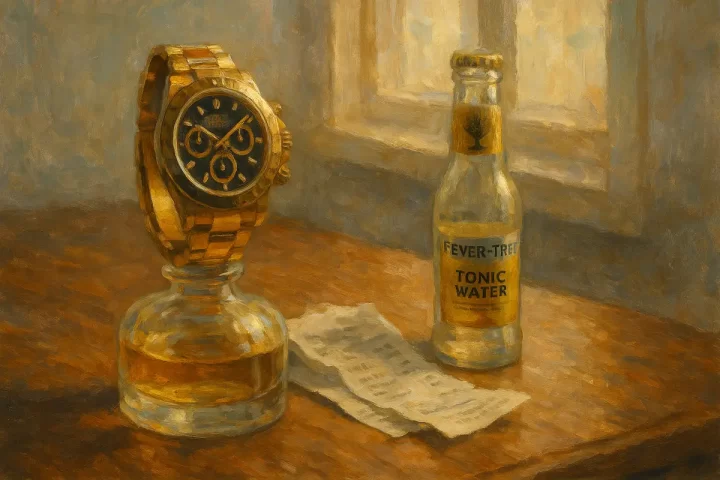
Today I am going to share with you the Fall letter I wrote to IMA clients. Due to its length, I’ll break it into three parts. In part one, I’ll discuss the rational irrationality of luxury goods and premium tonics. In part two, I’ll focus on what excellent management looks like at Babcock. And finally, in part three, I’ll conclude by taking you with me to London and Scotland. You can read the full letter here.
—
I am in awe of writing—I feel like I’m a guest on this journey. When I sat down to write this letter about my trip to London and Scotland with my son Jonah, I had a plan. I was going to talk about the musicals we saw, compare Scotland to New Zealand – both are green, full of sheep, have rolling hills, people speak with funny accents, drive on the wrong side of the road, and after all of that eventually get around to discussing Babcock’s investor day and how it’s a changed company. But after a few pages I was a bit surprised to discover that this is not where my writing muse took me. We’ll revert to my original plan, but in parts 2 and 3 of this essay.
Babcock – our largest holding and the second largest defense company in the UK – announced that in early September they were going to hold a marine investor day in Rosyth, Scotland (a suburb of Edinburgh). This wasn’t going to be just a presentation in an air-conditioned conference room but a tour of its shipbuilding yards. The moment I heard that, I said “road trip!”
I’m always looking for an excuse to visit Europe, especially when accompanied by my 24-year-old son Jonah. Though he’s well-traveled for his age, he’d never been to London, and I’ve never been to Scotland. IMA also owns two other British companies I wanted to visit – Watches of Switzerland (WOSG) and Fever Tree. Unfortunately, both companies were in their “quiet period” (the time when management is legally not allowed to meet with investors), so instead Jonah and I visited half a dozen WOSG stores in London, including their four-story flagship Rolex store, and did a fair amount of research on mixed drinks in UK restaurants and bars.
But despite not being able to meet with management, this trip turned out to be something even more valuable to me as an investor: a masterclass in businesses that have discovered the art of being rationally irrational.
The World of Luxury
Let’s start with the WOSG – it is the largest “retailer” (more on that later) of Swiss watches in the UK and the US.
When I start doing primary research, I sometimes get a bit too deep, especially if I really like the product. Before we owned WOSG, I was indifferent to mechanical watches, but when I was researching WOSG, I spent considerable time studying the watch industry and began to equally appreciate both the design (the art and craft) of mechanical watches and their marketing. Mechanical watches represent the last frontier of the analog world; everything else has been captured by digital.
There’s something beautiful and weirdly nostalgic about mechanical watches – they are one of the only remaining echoes of the analog past. Spend time with watch aficionados and you begin to appreciate the complexity and nuances of watchmaking – all those exotic functions (mostly unnecessary if we’re being completely honest) that they lovingly call “complications.”
What impresses me most is watchmakers’ attention to detail – their ability to pack so much functionality into a little round case. It’s craftsmanship in its purest form, where precision meets artistry in a space no bigger than a silver dollar.
If you think that the iPhone and Apple Watch have decimated the watch market, you’d be right – but only about the “low-end” of the watch market (those under a few thousand dollars). The high end remains alive and well (though it is coming off a serious pandemic bubble).
That’s because when you buy a Rolex (or any luxury mechanical watch), you’re not buying a device that tells time. You have a smartphone in your pocket, and you can get a quartz or electronic watch on Amazon for $10 (and a beautiful one for $25) that will keep time more accurately than a mechanical watch. What then is its purpose? Put simply, mechanical watches are men’s jewelry.
It turns out that there are several types of buyers of Swiss watches. There are those projecting status. Social scientists call this peacocking, signaling to the world they have extra money for frivolous trinkets (from an evolutionary perspective, they are showing potential mates that they can support them).
Then there are watch enthusiasts who are truly obsessed with them – who know tiny nuances, brand history, how they are made, and which movements they use. If you need a parallel from a familiar universe, think of your favorite American Civil War buff, minus the dressing up and reenactment (my brother Alex and Jonah fit into this category).
And then there are collectors. Some people collect stamps, others cars, and still others watches. (I suppose there is a tiny minority of buyers who actually wear watches to tell time.) I should note that these groups aren’t mutually exclusive and often overlap.
When it comes to marketing, Rolex is the center of my fascination. It is somewhat of a paradox —it is the largest maker of Swiss mechanical watches with about one-third market share, yet you still have to beg your authorized dealer to sell you a watch. It is like a dominatrix for rich people—they have to go through abuse from their Rolex dealers. That’s in part because demand for Rolex watches far outstrips supply (you can see this play out in the secondary market, where prices are often higher than in the store).
It probably costs Rolex less than a thousand dollars to manufacture a watch that sells for fifteen thousand. The gap between those numbers is explained by the story Rolex has so carefully crafted. They’ve mastered not just watchmaking but human psychology, turning a simple transaction into aspiration.
This is where retail comes in. Stores selling Rolex (and most luxury Swiss watches) are not traditional retailers but authorized dealers. Their model resembles auto dealerships: brands give out only a limited number of dealerships and are very selective about who gets them. This changes the business model’s economics and competitive dynamics tremendously, which is why I call WOSG a “retailer” in quotes.
We don’t typically own retail stocks – my EQ is very low when it comes to them, most don’t have moats, and I tend to lose money in them. But I don’t look at WOSG as a retailer; it’s a natural extension of luxury Swiss brands. If Walmart, Macy’s, or Target wanted to get into this business, they wouldn’t be able to. Unlike traditional retailing, where a store chooses which goods to sell from a distributor (and how many), Rolex and other Swiss brands tightly control who sells their watches and how many each dealer receives. Over the past decade, Rolex has been culling the herd—the number of Rolex authorized dealers in the US has declined by about a quarter to about 300, while sales increased.
The beauty of this authorized dealer model is that WOSG doesn’t need to worry about competition from a store opening next door. But they do need to be paranoid about their relationship with Rolex, which wants just one thing from retailers: a perfect customer experience that aligns with its story about its craftsmanship and obsession with quality.
This is why every authorized dealer is micromanaged by Rolex – down to where the Rolex counter sits within the store, how it looks, even what materials are used. If a retailer wants to remodel, blueprints and final design need Rolex approval. I heard a story about a McDonald’s opening on the same street as a Rolex authorized dealer who had operated from that location for decades. Rolex asked the retailer to move. On the surface it sounds absurd, but in my dive into the brand I realized the genius of this approach.
Let me give you a counterexample that illustrates just how crucial this controlled environment is. I was recently walking through a Macy’s store in Denver and saw a counter that sold Gucci watches. It was located right next to the loud, bustling shoe section. The display itself looked slightly scratched up and dusty with dim lighting, as if it had come from a pawn shop selling nose rings. This is precisely why Gucci is not known for its watches.
Our perception of a product is profoundly shaped not just by the product itself but by the environment around it. This insight doesn’t apply only to Rolex and other luxury goods. It’s why Apple is obsessed about the box the iPhone comes in, the look and location of its stores, the customer service experience, etc.
The perception of value imparted by the environment became crystal clear to me when I visited the Rolex store on Bond Street (London’s equivalent to NYC’s 5th Avenue). It was instantly clear that while WOSG may be running this store, it’s a guest at Rolex’s party. Rolex doesn’t want to retail its watches directly but needs partners that will care as much about client experience and storytelling as they do, and in WOSG they found the perfect match. As Jonah put it with a smile, “Watches of Switzerland has soul in the game.”
As long as WOSG continues to tell Rolex’s story to their standards, they’ll maintain that coveted relationship. For us as investors, WOSG is our way to indirectly own part of Rolex, as the brand accounts for a large chunk of WOSG’s revenues and profitability.
There’s another fascinating aspect to Rolex that makes it unique as an investment and explains its willingness to produce fewer watches than the market demands. Its founder had no descendants, so the company was left to a foundation that has an infinite time horizon, not just the next quarter. As a result, the company’s decision-making focuses on maximizing cash flows and preserving its brand; short-term growth is secondary. I wish all my companies could operate with such clarity.
This is harder than it sounds, especially for public companies where management tenure lasts only a few years and shareholders demand quarterly profit growth. Consider what happened to Coach, the maker of luxury handbags. It went on a growth spree and decided to open outlet stores. Its profitability skyrocketed … but then moms discovered their teenage daughters could buy the same Coach bag.
The issue wasn’t just logical (monetary) but also psychological: we hate to admit it, but we constantly compare ourselves to others. When your well-to-do friends carry Coach purses, your purse telegraphs that you share their social status. But when their kids start buying the same purses with their allowance money, the social hierarchy suddenly gets distorted. Demand collapsed, and the brand was nearly destroyed.
Sounds silly? Welcome to human psychology and luxury products, which require an infinite time horizon – a degree of patience that few companies can pull it off.
I am obsessed with quality and even romanticize it. That’s because a focus on quality puts you on the path to constant improvement. I admire companies that put quality front and center. We live in a world that prioritizes efficiency and the never-ending pursuit of lowering costs. That has been the story of industrialization and modern progress. But the artisan pursuit of quality – something you still see in luxury brands like Rolex watches, Louis Vuitton purses, and Ferrari cars – is an attempt to slow down time and elevate craftsmanship over efficiency.
This is why the luxury watch market is rationally irrational. On one hand, it makes sense to strive to do less and get more. Arguably this is why the quality of life has improved so much over the years. Instead of a donkey plowing a field, a mechanized, soon-to-be self-driving combine does the work. But in this pursuit of efficiency, we lose a bit of humanity, and these partially handmade, inefficient products fill that void. When someone buys a Rolex, they’re not just buying a watch – they’re buying into the idea that some things should take time, that mastery matters, and that there’s value in doing something the hard way.
Fever Tree
The same obsession with quality led me to another British company. In 2025 IMA bought a small (“venture”) position in Fever Tree. They make alcohol mixers, and their slogan explains their business model: “If ¾ of your drink is the mixer, mix with the best.”
The more I studied Fever Tree, the more fascinated I became. The company singlehandedly created the premium mixer category. They’ve captured the UK market for premium tonic water – the Brits are fond of their gin and tonic – and are synonymous with high-quality tonic. Just like Rolex, Fever Tree (which is run by a co-founder) is obsessed with quality. Industry interviews are filled with stories of their relentless pursuit of perfection.
And just like Rolex, Fever Tree obsesses over the perception of its product. They cannot control distribution like Rolex does, but they can control the bottle. You won’t find Fever Tree in plastic bottles. Most comes in glass bottles – occasionally cans, but never plastic. It’s priced several times higher than the low-end leader Schweppes, and customers happily pay the premium. After all, they just paid $50 for a bottle of vodka or gin, and want to mix it with another quality product. Charlie Munger could have licensed his saying to Fever Tree: “When you mix a turd with raisins, you get a turd.”
During the pandemic, glass prices have skyrocketed due to supply chain issues. Glass is Fever Tree’s largest cost item, and this has significantly dented the company’s profitability. Management could have relented and switched to plastic bottles, but it decided to endure short-term pain to preserve the brand. I admire that.
Let me make a not-so-obvious confession: I am a disgrace to Mother Russia. I don’t really drink. I haven’t had a straight shot of hard liquor since I was in college, and don’t even like the taste of wine. Part of me wishes I did; wine tasting looks like fun. My wife and I toured Coppola’s winery in Napa a decade ago, and after I sampled half a dozen wines, I politely asked for a beer. I am persona non grata at Coppola’s winery.
But now that I’ve discovered Fever Tree and mixed drinks, my alcohol consumption has gone up from a few drinks a year to a few a month. Since Jonah and I couldn’t visit management during their quiet period, we did field research the traditional way – we ordered gin and tonic everywhere we went (the lengths I go to!). On our trip we tried many competitive products, and though I may be biased, Fever Tree was our favorite by far.
After we returned to Denver, I asked my assistant to buy every Fever Tree product she could find. I wanted to try all the flavors. I posted this picture on x.com (you can follow me on x.com/vitaliyk) with the caption “Another day at the office… We take our research seriously.”

My friend Chris responded, “Now do PM [Philip Morris].” Chris and I are both shareholders of PM, the maker of Zyn, cigarettes, and other nicotine products. But I have to draw the line there: quitting smoking three decades ago was one of the most difficult things I ever did.
Just like Rolex, Fever Tree knows its strengths and weaknesses. They are brilliant at creating outstanding products and brand building, but are not as good at manufacturing and distribution. So they do what smart companies do – they outsource what they’re not good at. Fever Tree just signed a joint venture deal with Molson Coors to manufacture and distribute their products in the US. Get ready to see Fever Tree in more stores and bars over the next few years.
My wife, kids and I rarely drink traditional soda, but after our “research,” we started drinking Fever Tree ginger beer as a treat. It comes in many flavors, has very little sugar, and uses only natural ingredients. This represents a moonshot upside for the Fever Tree investment case – they become “adult soda,” a very nascent category in the UK.
My biggest concern is that management will have to walk a very fine line to stay premium and high-priced. I’m sure if they lowered prices, sales would surge initially, but this would mark the beginning of their demise as a brand. They’d lose their identity, could no longer afford the highest quality ingredients, and most importantly, consumers’ perception that they represent high quality would evaporate.
Key takeaways
- I look at Rolex’s enduring value and Fever Tree’s stock to understand how craftsmanship compounds over time.
- Rolex proves that brand control, scarcity, and obsession with quality build lasting worth.
- Fever Tree shows how staying true to your product—even when it hurts profits—protects long-term value.
- Both companies remind me that real excellence often looks irrational in the short term.
- The best investments, like the best craftsmanship, reward patience and purpose over speed.










Great article, love the humanness side to it and conversational tone, bravo & thank you. I’ve struggled personally to support biggie brands for all the obvious reasons, was surprised to read you do – not ethically conflicted V?
*ciggie (damm autocorrect must burn in hello ; )
The quality of things I feel extends to buildings as well. It used to be when the government built a court house or a post office, when banks built or a store like Eaton’s it was a “monument”. Now we get a functional building or a box in a retail store the old way you felt part of something important and it made you feel good just going in and you had respect for the institution now when you enter the new efficient operation you feel like another cog in the wheel. Churches are another example no matter how rich or poor you could/can go into “your” church and be part of something uplifting.
Dear Mr. Katsenelson, First, I would like to say that how much I enjoy reading your articles. You seem to be able to articulate your ideas with a rationality but also an emotional element. Regarding the Rolex article, while I agree with your assessment of what drives the demand for that product, I personally consider the product to be nothing more than an expensive bauble. In fact, the utilitarian aspect of the watch, which at one time(less than 40 years ago?)was necessary time tell time, has totally evaporated with the advent of the smartphone. So yes, I could afford to buy a Rolex, but to my mindset, it would be akin to flushing money down the toilet. Regarding the Fever Tree products, I have not tried them, and I will take your word for it that they are to some degree a product that is superior to the competition. But as a value investor, do you think that there might be another product that does an admiral job at a better price point? Maybe it is all about the branding, which is why bars no longer advertise “mixed drinks”, but rather “craft cocktails”, a euphemism that will allow for a higher margin sale.